Deep cycle agm battery replacement?

The 12v is only required to provide voltage to the computers and the hybrid battery starts the engine via the hybrid transmission.

That being said there is also a conventional starter that is powered by the 12v battery should the hybrid starter/system fail. The 12v starter is the exception starting method not the primary.
Thanks @EOD Guy !

So LC250 does have a starter!? Would it be able to possibly still charge the hybrid battery once engine is able to start?
My understanding is, the electric motor is also a generator, or there's once sandwich in between the motor and transmission somewhere? but no alternator?
 
Thanks @EOD Guy !

So LC250 does have a starter!? Would it be able to possibly still charge the hybrid battery once engine is able to start?
My understanding is, the electric motor is also a generator, or there's once sandwich in between the motor and transmission somewhere? but no alternator?
Yes the LC has a conventional 12v starter, no conventional alternator and the hybrid starter is part of the transmission and theoretically should the hybrid battery be drained to a point of a no start, the 12v battery could be charged/jumped or replaced and allow the conventional 12v starter to start the ICE, which would in turn replenish the hybrid battery.

I'm skeptical if one could ever drain the hybrid battery during normal operations unless there was a severe malfunction with the system. There are so many safety warnings/protocols on the LC, I just don't ever see it happening.
 
off subject...

I 've also read that the hybrid battery is meant to sit ~20-30% to ~80% for battery health and longevity. Maybe that's why it doesn't charge up to the full bars?

I did get a full bar charge once, didn't stay full very long
 
off subject...

I 've also read that the hybrid battery is meant to sit ~20-30% to ~80% for battery health and longevity. Maybe that's why it doesn't charge up to the full bars?

I did get a full bar charge once, didn't stay full very long

That is exactly why it doesn't charge to 100% or stay there very long. I have had full bars on the traction battery a couple of times, and it didn't stay that way for me either.
 
I expected you would find that battery a plus. So you get days of battery life vs. hours with the OEM battery- reason enough right there.

I believe I mentioned earlier in this thread I'd be upgrading my battery with an AGM deep cycle. For now, watching voltage on the OEM, and expect it'll go south once I get my new dashcam installed.
I run two Garmin dash cams for a couple of months now, a 310 in the front, and a mini 3 in the rear. So far, so good.
 
I run two Garmin dash cams for a couple of months now, a 310 in the front, and a mini 3 in the rear. So far, so good.

I recently picked up a Blackvue 2 channel (a newer version than what I ran for years on my previous vehicle). It is triggered by motion and impact in parking mode, which can be hard on the battery when you park in a busy place as I do for work.

The older version I ran on my Jeep would drain a battery pretty good even with a voltage protection circuit enabled. Adding an upgraded battery was half the battle.
 
For those concerned with battery draining to the point of stranding you, you could consider one of these priority savers. No idea if it works with our LCs. Ive used them in fleet vehicles and heavy equipment with excellent results. I carry a noco booster in all cars so i'm not considering installing one of these...yet.
 
Last edited:
If you're considering a solar panel to charge your battery, this video might help.

 
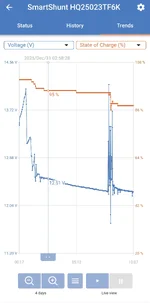
The LC charging system has a mind of its own, and I haven’t heard any theory that correctly describes the charge/discharge algorithm. Here’s a Victron Smartshunt record of battery voltage (blue line) and battery state of charge (SoC, red line). State of charge measured by the shunt tracks all current into and out of the battery. As I described in another post on this forum, it is much more accurate than merely measuring battery voltage to estimate SoC.

The record shows 4 days of data, starting after I charged the battery with a Noco charger. The spiky voltages at the right were when I drove the vehicle. This caused the battery voltage to fluctuate between higher and lower voltages, but the net result was to decrease the SoC from ~94% to ~88%, while simultaneously increasing so-called “surface charge” by perhaps a tenth of a volt or so. (This increase was mostly gone by the right side of the record, after the battery had a chance to rest.) Evidently, the battery was being drained faster than being charged while driving.

This record has a couple lessons for us. For those of us, like myself, who had been obsessed with whether switching to an AGM would result in the battery charging at optimal charging profile, the data suggest that the oem battery itself isn’t charged with an optimal profile.

Second, driving doesn’t necessarily increase battery SoC, particularly if voltage is high from an external charger.

My tentative hunch from looking at such data is that the charging algorithm prioritizes keeping the battery from draining “too much” rather than at optimum SoC.
 

Attachments

  • IMG_8982.webp
    IMG_8982.webp
    60.7 KB · Views: 114
The LC charging system has a mind of its own, and I haven’t heard any theory that correctly describes the charge/discharge algorithm. Here’s a Victron Smartshunt record of battery voltage (blue line) and battery state of charge (SoC, red line). State of charge measured by the shunt tracks all current into and out of the battery. As I described in another post on this forum, it is much more accurate than merely measuring battery voltage to estimate SoC.

The record shows 4 days of data, starting after I charged the battery with a Noco charger. The spiky voltages at the right were when I drove the vehicle. This caused the battery voltage to fluctuate between higher and lower voltages, but the net result was to decrease the SoC from ~94% to ~88%, while simultaneously increasing so-called “surface charge” by perhaps a tenth of a volt or so. (This increase was mostly gone by the right side of the record, after the battery had a chance to rest.) Evidently, the battery was being drained faster than being charged while driving.

This record has a couple lessons for us. For those of us, like myself, who had been obsessed with whether switching to an AGM would result in the battery charging at optimal charging profile, the data suggest that the oem battery itself isn’t charged with an optimal profile.

Second, driving doesn’t necessarily increase battery SoC, particularly if voltage is high from an external charger.

My tentative hunch from looking at such data is that the charging algorithm prioritizes keeping the battery from draining “too much” rather than at optimum SoC.
Looks like its idea of optimized is not dead.
I would be curious to see what the LC battery charging profile looks like when you pull a high 12v load, like a winch, with the car running.
Can you measure amps with that meter you have?
 
I hate to somewhat hijack the thread, but with all of the folks on here that seem to be pretty hip electrically I'm going to ask the question here.

I have a lighting set up on the way that is approximately 1800 watts @ 108 amps with everything turned on as bright as it will go. Not that I plan an driving around throwing 165,000 lumens down public highways, but with the way our systems charge, what are the educated guesses on what that would do to the system if I in fact did turn it all on? I believe I've read on here we don't have (and am embarrassed I've never looked to see) alternators, that our batteries are charged from the hybrid system. Does anyone know of a 2nd battery system installed yet in our rigs? For that kind of a draw would a guy run a second battery in parallel or series? If it was still 1998 and we were talking about a 2,000 watt stereo I'd just install a larger alternator etc, but we aren't there......
 
Looks like its idea of optimized is not dead.
I would be curious to see what the LC battery charging profile looks like when you pull a high 12v load, like a winch, with the car running.
Can you measure amps with that meter you have?
Yes, in addition to voltage and SoC it can measure current (amps) and cumulative current (amp hours since a specified start time). I have it wired to give the net total current into minus out of the battery. For example if the 12v DC load is 10 amps, and the LC’s DC-DC converter is supplying 7 amps, the shunt will read -3 amps. If the electrical system does this steadily for 1 hour, the shunt will report -3 amp hours.
For an example of measured current in my LC, see my post #18 in the thread: Observations and speculation of 12v-battery charging system
 
I hate to somewhat hijack the thread, but with all of the folks on here that seem to be pretty hip electrically I'm going to ask the question here.

I have a lighting set up on the way that is approximately 1800 watts @ 108 amps with everything turned on as bright as it will go. Not that I plan an driving around throwing 165,000 lumens down public highways, but with the way our systems charge, what are the educated guesses on what that would do to the system if I in fact did turn it all on? I believe I've read on here we don't have (and am embarrassed I've never looked to see) alternators, that our batteries are charged from the hybrid system. Does anyone know of a 2nd battery system installed yet in our rigs? For that kind of a draw would a guy run a second battery in parallel or series? If it was still 1998 and we were talking about a 2,000 watt stereo I'd just install a larger alternator etc, but we aren't there......
Good question regarding how much load we can safely get away with. [Definitely use (12v) batteries in parallel. In series you would end up with 24volts]. I would also like to know just how much the dc-dc converter can supply and more importantly for how long (duty cycle) before damaging something. Not sure Toyota planned on us connecting high current loads to the 12v system.
 
Good question regarding how much load we can safely get away with. [Definitely use (12v) batteries in parallel. In series you would end up with 24volts]. I would also like to know just how much the dc-dc converter can supply and more importantly for how long (duty cycle) before damaging something. Not sure Toyota planned on us connecting high current loads to the 12v system.
Yes parallel connect only on added battery. Question is where to put it?
 
Yes parallel connect only on added battery. Question is where to put it?

I haven't searched too hard, but I have yet to see a dual battery solution for the Land Cruiser platform (yet). I have seen them for Jeeps (Genesis), previous generation 4Runners (Genesis), but crickets on the LC250 front thus far.
 
Yes parallel connect only on added battery. Question is where to put it?
IMO, a 2nd 12v could only be located in the engine compartment. I suppose if one didn't mind a big ole battery hanging out in the cargo area, that would work or if someone didn't mind it hanging underneath the vehicle that would also work.

(edit) I'm pretty sure the smaller battery designed for some Jeeps (at least my YJ had a much thinner one, maybe a group 24R, I don't remember exactly) might easily fit under the hood.
 
I run two Garmin dash cams for a couple of months now, a 310 in the front, and a mini 3 in the rear. So far, so good.
I am trying to do the same with a x310 front and mini 3 rear. How did you power each camera? I was thinking the front using a Dongar Pus and the rear to the engine fuse box. Is there an easier way? Do yours include the parking option? Thank you
 
I am trying to do the same with a x310 front and mini 3 rear. How did you power each camera? I was thinking the front using a Dongar Pus and the rear to the engine fuse box. Is there an easier way? Do yours include the parking option? Thank you
Welcome to the asylum FirstC1035.

I chose not to tap into the fuse box/panel. When I installed my X310 and Mini 3, there were no Donger thingamajiggers to be found.. sold out. So I ordered the Garmin part that plugs into the OBD plug, which will power both of the dash cams. You will also have to purchase the Garmin extra long power cable to make it from the rear Mini 3 to the OBD plug.

There will be lots of left over power cord(s), which are easily coiled and secured with zip ties up and out of sight above and behind the plug.

The Garmin OBD plug has a little switch on it which lets you chose how long the camera(s) will record after turning the vehicle off. Initially I had it set for the longest setting, but when the OEM defective battery debacle began, I changed the setting to the shortest time interval.

You will want to enter the vehicle carefully so that you are not always kicking the OBD power plug, DAMHIKT. 😬

IMG_9404.webp
 
Supporting Vendors View all →
Back
Top Bottom