Changing 12v Battery

Sorry I don't recall seeing in your thread, or maybe I just forgot, but what is the measured output of your solar charger? Trying to see how much of your battery issue is solved with the Optima vs the solar charger
To be honest, I've never measured it. Normally I'd have to hook up a trickle charger while working on it, with the solar charger, it wasn't necessary. I did find the limit of the new battery+solar charger........ about three 6 hr days of normal open/closed doors while working on it. It's been a few months now and I've only had one instance of a flat battery (that's when I discovered the 3 days).
 
I want to pass on my experience with upgrading my battery, twice. I'm not recommending anything in particular here, just sharing the data for your use...

Background: I know that I don't drive my LC long enough distances each day for the hybrid system to keep my 12V battery charged (I typically only drive a short distance each way daily, often totaling only 10-15 minutes for the day). This, coupled with the fact that the 12V battery seems to drain VERY quickly when any load is placed on it, means that the 12V battery issue is a big concern for me (thus I'm in the process of trading in my LC for a different vehicle).

Optima: Not too long after I purchased my LC, I upgraded to an Optima battery. I've had this battery for a year now, and I find that even after doing a full recharge with a Noco charger, the battery voltage/charge drops very quickly over time. On a recent test, which yielded results very typical for this battery, in just 5 days the voltage (measured after sitting all night) had dropped below 12.4V (Optima says that you should try to keep the voltage above 12.4V in order to avoid damaging the battery thru sulfation of the plates):

1/20: Full charge (Noco wall charger)
1/20: Two hours after the charge: 12.71V, 100% charge, 100% health
1/21: 12.61V, 100% charge
1/22: 12.54V, 90% charge
1/23: 12.46V, 75% charge
1/24: 12.40V, 65% charge
1/25: 12.35V, 58% charge

Odyssey: Repeating the same test, with virtually identical conditions, the LC was still unable to keep the battery topped off -- but the Odyssey performed much better, in that the voltage/charge drop was much slower than that with the Optima. It took 12 days for the Odyssey to drop below the 12.4V level:

1/26: I didn't specifically recharge the (new) battery, but it tested with 100% charge & 100% health
1/27: 12.63V, 100% charge
1/28: 12.61V, 100% charge
1/29: 12.59V, 97% charge
1/30: 12.56V, 93% charge
1/31: 12.54V, 89% charge
2/1: 12.53V, 88% charge
2/2: 12.48V, 80% charge
2/3: 12.47V, 78% charge
2/4: 12.45V, 74% charge
2/5: 12.41V, 65% charge
2/6: 12.40V, 65% charge
2/7: 12.39V, 63% charge

I should note that (unfortunately for testing purposes) I did not recharge the (new) Odyssey battery before using it, and I did not capture the starting voltage (oops!). But I speculate that the battery was not COMPLETELY topped off (if it were so, I'd of expected a slightly higher voltage on the first day). That would make the results in favor of the Odyssey even more compelling...

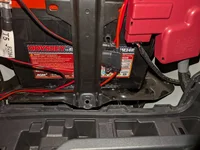
The Odyssey that I have is an Extreme series model, and unfortunately, it doesn't fit perfectly in the LC (the overall battery size is the same as the OEM, but the battery hold bracket cannot quite fit completely over the top of battery (see photo below). That said, even when not using the front bolt of the battery hold-down clamp, the battery seems to be held tightly in place by the two back bolts. You will probably be able to get the bracket attached in the front if you use a slightly longer bolt.
- Odyssey Extreme series: ODX-AGM34R -- $372.39 at Napa Auto Parts (20% off sale)
- Length/width/height: 10.9/6.8/7.3 (posts are higher at 7.9)
- 850 CCA, 135 minutes reserve capacity

That said, Odyssey makes a Performance series model that (I think) should be a perfect fit for the LC:
- Odyssey Performance series: ODP-AGM 48 H6 L3 -- $317.19 at Napa Auto Parts (20% off sale)
- Length/width/height: 10.9/6.9/7.5
- 760 CCA, 130 minutes reserve capacity
 

Attachments

  • Odyssey Battery.webp
    Odyssey Battery.webp
    212.5 KB · Views: 144
Last edited:
Thanks for sharing such detailed battery info.

What vehicle are you getting?
 
Thanks for sharing such detailed battery info.

What vehicle are you getting?
To preface -- my use case is probably different from many folks that buy an LC... I live in the CO mountains (at 8600 feet elevation), and I'm retired and spend TONS of time in the backcountry -- camping, hiking, backpacking -- and typically in very remote areas. But, I'm not out looking for rock-crawling challenges or anything like that -- rather, I'm almost always on forest "roads" of one sort or another. The reason I wanted the off-road goodies on the LC was to provide an extra margin of capability in the event that I ever get myself stuck or in a pickle!

That said -- and I know that this is definitely not an apples-to-apples comparison -- I'm going to get a Subaru Outback Wilderness. It's a 4 cyl turbo, but not a hybrid -- so I get a full size battery. And while it does not offer all the hard-core stuff that the LC has (low range, lockers, big tires, etc.), it does offer a number of things that will be very useful for me (esp. the dynamic adaptive suspension, along with a bit higher ground clearance of 9.5 inches). I don't necessarily love the looks of the Outback (like I do the LC), and I'll definitely miss the uniqueness of the LC, but overall I think the change is the right move for me.
 
I want to pass on my experience with upgrading my battery, twice. I'm not recommending anything in particular here, just sharing the data for your use...

Background: I know that I don't drive my LC long enough distances each day for the hybrid system to keep my 12V battery charged (I typically only drive a short distance each way daily, often totaling only 10-15 minutes for the day). This, coupled with the fact that the 12V battery seems to drain VERY quickly when any load is placed on it, means that the 12V battery issue is a big concern for me (thus I'm in the process of trading in my LC for a different vehicle).

Optima: Not too long after I purchased my LC, I upgraded to an Optima battery. I've had this battery for a year now, and I find that even after doing a full recharge with a Noco charger, the battery voltage/charge drops very quickly over time. On a recent test, which yielded results very typical for this battery, in just 5 days the voltage (measured after sitting all night) had dropped below 12.4V (Optima says that you should try to keep the voltage above 12.4V in order to avoid damaging the battery thru sulfation of the plates):

1/20: Full charge (Noco wall charger)
1/20: Two hours after the charge: 12.71V, 100% charge, 100% health
1/21: 12.61V, 100% charge
1/22: 12.54V, 90% charge
1/23: 12.46V, 75% charge
1/24: 12.40V, 65% charge
1/25: 12.35V, 58% charge

Odyssey: Repeating the same test, with virtually identical conditions, the LC was still unable to keep the battery topped off -- but the Odyssey performed much better, in that the voltage/charge drop was much slower than that with the Optima. It took 12 days for the Odyssey to drop below the 12.4V level:

1/26: I didn't specifically recharge the (new) battery, but it tested with 100% charge & 100% health
1/27: 12.63V, 100% charge
1/28: 12.61V, 100% charge
1/29: 12.59V, 97% charge
1/30: 12.56V, 93% charge
1/31: 12.54V, 89% charge
2/1: 12.53V, 88% charge
2/2: 12.48V, 80% charge
2/3: 12.47V, 78% charge
2/4: 12.45V, 74% charge
2/5: 12.41V, 65% charge
2/6: 12.40V, 65% charge
2/7: 12.39V, 63% charge

I should note that (unfortunately for testing purposes) I did not recharge the (new) Odyssey battery before using it, and I did not capture the starting voltage (oops!). But I speculate that the battery was not COMPLETELY topped off (if it were so, I'd of expected a slightly higher voltage on the first day). That would make the results even more compelling...

The Odyssey that I have is an Extreme series model, and unfortunately, it doesn't fit perfectly in the LC (the overall battery size is the same as the OEM, but the battery hold bracket cannot quite fit completely over the top of battery (see photo below). That said, even when not using the front bolt of the battery hold-down clamp, the battery seems to be held tightly in place by the two back bolts. You will probably be able to get the bracket attached in the front if you use a slightly longer bolt.
- Odyssey Extreme series: ODX-AGM34R -- $372.39 at Napa Auto Parts (20% off sale)
- Length/width/height: 10.9/6.8/7.3 (posts are higher at 7.9)
- 850 CCA, 135 minutes reserve capacity

That said, Odyssey makes a Performance series model that (I think) should be a perfect fit for the LC:
- Odyssey Performance series: ODP-AGM 48 H6 L3 -- $317.19 at Napa Auto Parts (20% off sale)
- Length/width/height: 10.9/6.9/7.5
- 760 CCA, 130 minutes reserve capacity

Yep, that seems to track with the land cruisers charging profiles, I'm really surprised so many people on this forum push the whole deep cycle agm batteries, the system simply can't charge them. People have been saying they have no problems, but they are going to prematurely fail unless constantly plugging it in which is not something I'm interested in. but to each their own, it's your car, do what you want.
 
To preface -- my use case is probably different from many folks that buy an LC... I live in the CO mountains (at 8600 feet elevation), and I'm retired and spend TONS of time in the backcountry -- camping, hiking, backpacking -- and typically in very remote areas. But, I'm not out looking for rock-crawling challenges or anything like that -- rather, I'm almost always on forest "roads" of one sort or another. The reason I wanted the off-road goodies on the LC was to provide an extra margin of capability in the event that I ever get myself stuck or in a pickle!

That said -- and I know that this is definitely not an apples-to-apples comparison -- I'm going to get a Subaru Outback Wilderness. It's a 4 cyl turbo, but not a hybrid -- so I get a full size battery. And while it does not offer all the hard-core stuff that the LC has (low range, lockers, big tires, etc.), it does offer a number of things that will be very useful for me (esp. the dynamic adaptive suspension, along with a bit higher ground clearance of 9.5 inches). I don't necessarily love the looks of the Outback (like I do the LC), and I'll definitely miss the uniqueness of the LC, but overall I think the change is the right move for me.
Most people don't take their LC off road anyways, Subaru makes a good vehicle, I think you'll like the outback. I love a nice wagon.

Hope it works out, I'm currently doing research for a replacement for my LC as well. I'm glad others are enjoyable by their car but my LC is a complete piece of shit compared to my GX460 and wish I hadn't of bought it. Thinking of just going back to the GX but want the more modern safety features. Not really anything comparable, might have to wait and see what the Xterra looks like.
 
Most people don't take their LC off road anyways, Subaru makes a good vehicle, I think you'll like the outback. I love a nice wagon.

Hope it works out, I'm currently doing research for a replacement for my LC as well. I'm glad others are enjoyable by their car but my LC is a complete piece of shit compared to my GX460 and wish I hadn't of bought it. Thinking of just going back to the GX but want the more modern safety features. Not really anything comparable, might have to wait and see what the Xterra looks like.
I agree, I've been looking for something to replace the LC for a while now. The Outback is a new gen in 2026, and the Wilderness model is just arriving at dealers now, so I went ahead and pulled the trigger.

If Nissan really does come out with an Xterra -- I'd definitely be up for looking seriously at that. I had a 2015 Xterra Pro-4X, but replaced it with a Jeep Cherokee Trailhawk after 3 years... The Xterra was great, but had two big issues: Absolutely NO modern safety tech at all, and it only had part-time 4WD. The latter doesn't work for me -- as up here in the mountains thru the winter, it's almost constant mixed road conditions of clear/snow/ice, and I can't be constantly turning 4WD on and off...
 
Yep, that seems to track with the land cruisers charging profiles, I'm really surprised so many people on this forum push the whole deep cycle agm batteries, the system simply can't charge them. People have been saying they have no problems, but they are going to prematurely fail unless constantly plugging it in which is not something I'm interested in. but to each their own, it's your car, do what you want.

I want to say most of us that off-road push AGM technology as it's far more resilient to going flat in a few days of non-use, and they will typically hold a charge for several months. The charging profile isn't ideal for any battery type. In all honesty, the OEM lead acid battery for the LC 250 should be tossed in a landfill.

I've never had an issue with the OEM lead acid, but there's something called pattern recognition - and replacing it BEFORE it fails, in my case, on the White Rim Trail for instance, is preventative maintenance. I also don't place much trust in it while winching at 300A, it's sub-optimal for about anything other than starting an I4 engine, which it fails even at that (for many in this board) in the winter months.

Toyota gave us a great starting platform, it's insanely capable. It really needs only a few modifications to be great (winch, bull bar, tires, skid plates, rock sliders, AGM battery, 1-2kW power bank for fridge and inverter cooker, and recovery gear). I'm on the trail virtually every weekend with ours, it will go about anywhere outside of where you'd take a Jeep Rubicon on 37's.
 
Last edited:
I’ve been following all of the battery threads trying to decide on whether to pro-actively replace the OEM lead-acid one and if so whether to go with flooded lead-acid, deep cycle AGM, or non-deep cycle AGM.

My experience with the OEM battery has so far been very good. I once left the rear door open for at least 12 hours with the hatch-mounted interior cargo lights on (forgot to close the hatch) - lights were still on and no problem immediately starting. This past week my LC-FE was parked outside for a couple of nights with 0F low temps. Started up fine on both days when temp was a few degrees higher.

I have a NoCo but haven’t had to use it.

The LC is about 21 months old.
 
Yep, that seems to track with the land cruisers charging profiles, I'm really surprised so many people on this forum push the whole deep cycle agm batteries, the system simply can't charge them. People have been saying they have no problems, but they are going to prematurely fail unless constantly plugging it in which is not something I'm interested in. but to each their own, it's your car, do what you want.

As far as "pushing" AGM deep cycle batteries, I have owned a few and appreciate them but don't push them. Not everyone wants more battery capability or the maintenance that comes with. Their main advantage in a vehicle that has too little battery capacity is that if they become discharged they bounce back on recharge without permanent degradation like a typical starting battery will see. When my OEM battery poops the bed, I'll get one for the Land Cruiser with the knowledge it'll need to be topped off with a charger periodically.

To say they need to be constantly plugged in wouldn't be accurate. I ran a 2 channel dash cam that was motion and impact activated in my previous vehicle, and when parking at work that meant the cams were going the entire time I left the vehicle. With that kind of regular drain, I was topping off my Odyssey around once per month to keep it happy. Without the dash cam that may have meant a much longer duration between charges. I have a similar cam I intend to install in the Land Cruiser, and that would likely mean experiencing a dead battery pretty regularly- with a flooded lead acid or starting AGM battery, that means I'd have to replace the battery more often if the cams ran it below 10V.

I agree that you should skip it if maintaining the battery isn't something you wish to be doing, as AGM deep cycles do need to be periodically charged. How often that is is based on the rate of discharge, which will vary from one user to the next.
 
As far as "pushing" AGM deep cycle batteries, I have owned a few and appreciate them but don't push them. Not everyone wants more battery capability or the maintenance that comes with. Their main advantage in a vehicle that has too little battery capacity is that if they become discharged they bounce back on recharge without permanent degradation like a typical starting battery will see. When my OEM battery poops the bed, I'll get one for the Land Cruiser with the knowledge it'll need to be topped off with a charger periodically.

To say they need to be constantly plugged in wouldn't be accurate. I ran a 2 channel dash cam that was motion and impact activated in my previous vehicle, and when parking at work that meant the cams were going the entire time I left the vehicle. With that kind of regular drain, I was topping off my Odyssey around once per month to keep it happy. Without the dash cam that may have meant a much longer duration between charges. I have a similar cam I intend to install in the Land Cruiser, and that would likely mean experiencing a dead battery pretty regularly- with a flooded lead acid or starting AGM battery, that means I'd have to replace the battery more often if the cams ran it below 10V.

I agree that you should skip it if maintaining the battery isn't something you wish to be doing, as AGM deep cycles do need to be periodically charged. How often that is is based on the rate of discharge, which will vary from one user to the next.
Not sure why more people don't run LVD's on these accessories. No need to worry about it.
 
Not sure why more people don't run LVD's on these accessories. No need to worry about it.

I did- the settings weren't optimum. The most appropriate voltage cut off amongst the options was 12V, and with a flooded lead acid battery that isn't necessarily enough to light up the ECU to allow a start.

When I upgraded to a Northstar AGM deep cycle, and eventually an Odyssey AGM deep cycle when the Northstar left the building, they would still start my Jeep when discharged as low as 11.3V due to the extra reserve. Low voltage was my cue to top off the battery overnight. I was weighing potential loss of footage against a no-start condition with my cam and eventual battery choice. I expect the smaller Land Cruiser battery to be easily discharged with a dash cam in a similar setting, and know I won't be able to stick a battery as large as my Odyssey Performance series in the space allotted (I upsized when I purchased my last Odyssey).

My new dash cam has a better range of target low voltage cut offs as options, and I hope to have a little redundancy on the upgraded battery itself.
 
I’ve been following all of the battery threads trying to decide on whether to pro-actively replace the OEM lead-acid one and if so whether to go with flooded lead-acid, deep cycle AGM, or non-deep cycle AGM.

My experience with the OEM battery has so far been very good. I once left the rear door open for at least 12 hours with the hatch-mounted interior cargo lights on (forgot to close the hatch) - lights were still on and no problem immediately starting. This past week my LC-FE was parked outside for a couple of nights with 0F low temps. Started up fine on both days when temp was a few degrees higher.

I have a NoCo but haven’t had to use it.

The LC is about 21 months old.

My neighbour is always leaving the hatch or door open on his Hyundai and discharging his battery. He uses my battery charger more than I do 🤨

I believe he is on his 3rd battery in the five years we have known him. I tried to point him towards an AGM deep cycle after he killed the previous battery for good, but he said “too expensive.”

Not everyone gets into a position where they run their battery down regularly, so not everyone needs or would benefit from paying the extra for a battery that can be recharged 200-400 times with no serious reduction in performance.

My normal work commute is about 11 minutes, so I know I’ll see a partial state of charge on the battery without the occasional intervention.
 
To preface -- my use case is probably different from many folks that buy an LC... I live in the CO mountains (at 8600 feet elevation), and I'm retired and spend TONS of time in the backcountry -- camping, hiking, backpacking -- and typically in very remote areas. But, I'm not out looking for rock-crawling challenges or anything like that -- rather, I'm almost always on forest "roads" of one sort or another. The reason I wanted the off-road goodies on the LC was to provide an extra margin of capability in the event that I ever get myself stuck or in a pickle!

That said -- and I know that this is definitely not an apples-to-apples comparison -- I'm going to get a Subaru Outback Wilderness. It's a 4 cyl turbo, but not a hybrid -- so I get a full size battery. And while it does not offer all the hard-core stuff that the LC has (low range, lockers, big tires, etc.), it does offer a number of things that will be very useful for me (esp. the dynamic adaptive suspension, along with a bit higher ground clearance of 9.5 inches). I don't necessarily love the looks of the Outback (like I do the LC), and I'll definitely miss the uniqueness of the LC, but overall I think the change is the right move for me.
I have both the 26 LC and 26 Outback. They're completely different animals.
 
As far as "pushing" AGM deep cycle batteries, I have owned a few and appreciate them but don't push them. Not everyone wants more battery capability or the maintenance that comes with. Their main advantage in a vehicle that has too little battery capacity is that if they become discharged they bounce back on recharge without permanent degradation like a typical starting battery will see. When my OEM battery poops the bed, I'll get one for the Land Cruiser with the knowledge it'll need to be topped off with a charger periodically.
I think we'll soon be discussing lithium 12V batteries like Antigravity and Optima Orange Top as prices begin to fall. They both have built in management systems shut down automatically when they become discharged, preserving enough charge to allow a self jump/remote restart, which can also be monitored on a phone app. The Antigravity has 40AH and 60 AH configurations, while the Optima is currently 45AH. The lithium batteries also discharge more slowly and recharge faster than lead acid/AGM. For those in cold areas Antigravity specs storage to about -4F and the Optima -20F.
And of course just like with deep cycle AGMs, battery manufacturers confirm compatibility with ordinary, OEM vehicle charging systems, with no modifications needed!
Currently these batteries are popular with the sports car crowd that does not daily their cars, but it's likely their use will continue to expand.
 
  • Like
Reactions: SJR
I want to pass on my experience with upgrading my battery, twice. I'm not recommending anything in particular here, just sharing the data for your use...

Background: I know that I don't drive my LC long enough distances each day for the hybrid system to keep my 12V battery charged (I typically only drive a short distance each way daily, often totaling only 10-15 minutes for the day). This, coupled with the fact that the 12V battery seems to drain VERY quickly when any load is placed on it, means that the 12V battery issue is a big concern for me (thus I'm in the process of trading in my LC for a different vehicle).

Optima: Not too long after I purchased my LC, I upgraded to an Optima battery. I've had this battery for a year now, and I find that even after doing a full recharge with a Noco charger, the battery voltage/charge drops very quickly over time. On a recent test, which yielded results very typical for this battery, in just 5 days the voltage (measured after sitting all night) had dropped below 12.4V (Optima says that you should try to keep the voltage above 12.4V in order to avoid damaging the battery thru sulfation of the plates):

1/20: Full charge (Noco wall charger)
1/20: Two hours after the charge: 12.71V, 100% charge, 100% health
1/21: 12.61V, 100% charge
1/22: 12.54V, 90% charge
1/23: 12.46V, 75% charge
1/24: 12.40V, 65% charge
1/25: 12.35V, 58% charge

Odyssey: Repeating the same test, with virtually identical conditions, the LC was still unable to keep the battery topped off -- but the Odyssey performed much better, in that the voltage/charge drop was much slower than that with the Optima. It took 12 days for the Odyssey to drop below the 12.4V level:

1/26: I didn't specifically recharge the (new) battery, but it tested with 100% charge & 100% health
1/27: 12.63V, 100% charge
1/28: 12.61V, 100% charge
1/29: 12.59V, 97% charge
1/30: 12.56V, 93% charge
1/31: 12.54V, 89% charge
2/1: 12.53V, 88% charge
2/2: 12.48V, 80% charge
2/3: 12.47V, 78% charge
2/4: 12.45V, 74% charge
2/5: 12.41V, 65% charge
2/6: 12.40V, 65% charge
2/7: 12.39V, 63% charge

I should note that (unfortunately for testing purposes) I did not recharge the (new) Odyssey battery before using it, and I did not capture the starting voltage (oops!). But I speculate that the battery was not COMPLETELY topped off (if it were so, I'd of expected a slightly higher voltage on the first day). That would make the results in favor of the Odyssey even more compelling...

The Odyssey that I have is an Extreme series model, and unfortunately, it doesn't fit perfectly in the LC (the overall battery size is the same as the OEM, but the battery hold bracket cannot quite fit completely over the top of battery (see photo below). That said, even when not using the front bolt of the battery hold-down clamp, the battery seems to be held tightly in place by the two back bolts. You will probably be able to get the bracket attached in the front if you use a slightly longer bolt.
- Odyssey Extreme series: ODX-AGM34R -- $372.39 at Napa Auto Parts (20% off sale)
- Length/width/height: 10.9/6.8/7.3 (posts are higher at 7.9)
- 850 CCA, 135 minutes reserve capacity

That said, Odyssey makes a Performance series model that (I think) should be a perfect fit for the LC:
- Odyssey Performance series: ODP-AGM 48 H6 L3 -- $317.19 at Napa Auto Parts (20% off sale)
- Length/width/height: 10.9/6.9/7.5
- 760 CCA, 130 minutes reserve capacity
Just a quick update re the Odyssey battery...

I've now completed a full charge/rest/test cycle for the battery, and rested it shows 12.79V and 100% charge. This means that when I originally ran the test on the new battery (and neglected to recharge it before using it), it was only partially charged (i.e., it was showing 12.63V, vs. today when I fully charged and rested the battery, it is at 12.79V). So THAT means that the partially (but mostly) charged Odyssey lasted almost 2 and a half times longer than my Optima - and presumably, if the Odyssey was fully charged before the test, it would have beaten the Optima by even more!!

The Odyssey is a totally different animal. I fully charged it with my Noco yesterday, worked on the car for an hour or so with the liftgate and doors open yesterday, and then let it sit overnight -- and this morning it's still showing 12.77V and 100% charge. This is waaaaay smaller a drop than I would expect with the Optima.

I should note, I've tested my Optima many times (with my TopDon BT-100 battery tester/analyzer), and AutoZone tested the battery when I bought it, and Toyota also tested the battery during my last service. All tests yielded the same results: the Optima showed 100% healthy. So I have no real explanation for the huge difference in performance between the Optima and the Odyssey.

While this doesn't change the fact that the LC has a painfully small battery -- my experience with the Odyssey has changed the game altogether for me.
 
I have both the 26 LC and 26 Outback. They're completely different animals.
Yep, very true! BTW, mine is an Outback Wilderness, which has some different stuff from the non-Wilderness Outbacks.

But now, with my recent results using an Odyssey Extreme battery, I'm (possibly) reconsidering the purchase of the Outback. Still sitting on the fence at this point (my Outback doesn't arrive until the last week in Feb, so I have some time to think about it).
 
Yep, very true! BTW, mine is an Outback Wilderness, which has some different stuff from the non-Wilderness Outbacks.

But now, with my recent results using an Odyssey Extreme battery, I'm (possibly) reconsidering the purchase of the Outback. Still sitting on the fence at this point (my Outback doesn't arrive until the last week in Feb, so I have some time to think about it).
We got the touring XT for the engine, it complements the car very well
 
Just a quick update re the Odyssey battery...

I've now completed a full charge/rest/test cycle for the battery, and rested it shows 12.79V and 100% charge. This means that when I originally ran the test on the new battery (and neglected to recharge it before using it), it was only partially charged (i.e., it was showing 12.63V, vs. today when I fully charged and rested the battery, it is at 12.79V). So THAT means that the partially (but mostly) charged Odyssey lasted almost 2 and a half times longer than my Optima - and presumably, if the Odyssey was fully charged before the test, it would have beaten the Optima by even more!!

The Odyssey is a totally different animal. I fully charged it with my Noco yesterday, worked on the car for an hour or so with the liftgate and doors open yesterday, and then let it sit overnight -- and this morning it's still showing 12.77V and 100% charge. This is waaaaay smaller a drop than I would expect with the Optima.

I should note, I've tested my Optima many times (with my TopDon BT-100 battery tester/analyzer), and AutoZone tested the battery when I bought it, and Toyota also tested the battery during my last service. All tests yielded the same results: the Optima showed 100% healthy. So I have no real explanation for the huge difference in performance between the Optima and the Odyssey.

While this doesn't change the fact that the LC has a painfully small battery -- my experience with the Odyssey has changed the game altogether for me.
What size noco are you using for the trickle charge?
 
What size noco are you using for the trickle charge?
Most of the time I use the Genius 2 (2 amp), it's a slow charge which is best for the battery. I also have a Genius 5 for times that I'm in more of a hurry. Note that the LC owner's manual states that you should not use a charger with more than 5 amps (it says that it could cause the battery to explode!)
 
Supporting Vendors View all →
Air Down Gear
Back
Top Bottom