Solution for weak 12v battery which occurs in most hybrid vehicles and LC250 ?

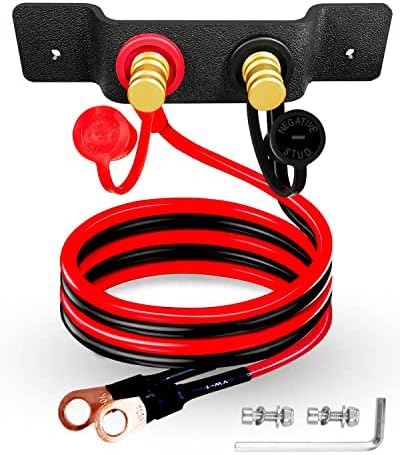
Before dealer replaced with the new battery last Saturday, I kept use jump start many times that I was so tired…Instead of keep opening the hood for jump start, I had a dedicated Anderson plug connected to rear battery and run all the way to area behind rear seat for easier access.

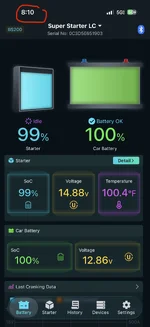
The new battery is so far so good after 1 day (still 95-100 % / above 12.7 v). I often monitor the charge / voltage of new battery and BS200 through my phone Bluetooth (very convenient )

Probably, this weekend I will test by opening the hatch doors and set time to see how long the brand new battery will be lasted (drained out to 5% charge / under 10 voltage) and how BS200 will start the engine…
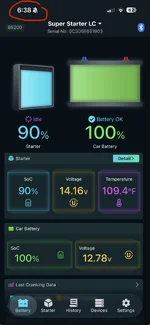
 

Attachments

  • IMG_7095.webp
    IMG_7095.webp
    93.5 KB · Views: 48
  • IMG_7096.webp
    IMG_7096.webp
    94.9 KB · Views: 43
I lifted this diagram from another thread here I believe. My understanding was that at vehicle startup the 12v starter was always used. The hybrid motor is used for star/stop during operation.

I don't personally know, just going on what I read here and elsewhere.

View attachment 71751
I was wrong. I read somewhere that ours didnt have the starter motor, only the LX did in usa, but memory was distorted. It is the ancilliary belt alternator we dont have.

I need to stop posting while dozing off or trying to wake up.


Last edited:
Question - Is a contributing factor to our LC H6 battery problem we are not using them enough? Starting to question that scenario since the hybrid DC battery & motor-generator is the primary way to start the US spec LC engine.

There is obviously a lead-acid 12v starter, but reading about the system it sounds like it is not always used & favors the hybrid motor to start the engine. That would imply the 12v battery is really used most of the time to energize the on board electronic systems.

Some flooded lead batteries don’t do too well not being exercised. The is a reason there are different lead deep cycle & starter battery profiles. Could these OE early battery failures just be they weren’t exercised deep enough without enough start cycles on them creating a weak memory for when guts are needed? Add in sulfation & the DC short voltage charging levels that might make that a tough profile for a AGM or lead acid battery. Wondering if there is a situation where the 12v battery & starter is used, & could we force that to happen more than it does.

Asking for a friend.
 
Last edited:
What about a Lensu hood solar panel? I had one in my Tacoma and never had battery problems even running the radio for more than an hour, of course the sun was always hitting the solar panel, and it look good as well.
 
Every time you open the gas door it forces standard starter use on next ignition cycle.
Helluva a nugget! Thank you Bad1975!
 
What about a Lensu hood solar panel? I had one in my Tacoma and never had battery problems even running the radio for more than an hour, of course the sun was always hitting the solar panel, and it look good as well.
Welcome to the asylum.

Your avatar cracks me up!!! 🤣
 
I will check with dealer if it is still under manufacture warranty and probably it can be replaced for “free” ;)
Anyway, I hope the 2 methods I mentioned will bring a huge peace of mind while in remote/ overland
Go to Walmart and spend $160 on an H6 AGM, there are only a handful of battery manufacturers left in America. The cost will be the last thing on your mind while overlanding.

The poverty spec OEM battery deserves to be in the trash, not in a land cruiser.
 
I had the 12V battery fail this winter when it was minus 35C. My LC was about 18 months old at that point. I figured no problem - I'd use my jump starter - so hooked it up & hit start only it didn't start - wouldn't turn over - instead got a message to see dealer. Got out the manual and soon discovered that there was probably a low voltage issue so the system basically shut down to prevent damage to the electronics. Called Toyota assist & they dispatched a tow truck. Tow driver figures no problem he'll jump start it - Nothing - so he will load it on the tow truck & haul it to the dealer. Hooked it up and was about to pull it onto the deck except the e-brake on my LC wouldn't release as the 12V battery was dead. When he was about to drag it on with the e-brake engaged I intervened & told him I wanted a dolly as dragging it could do damage. Next tow truck came with a dolly - EXCEPT - it was for a car and the LC weighed too much to haul it any distance. Called another tow truck - so finally after 3 tow trucks and waiting in munis 35C weather, it got to the dealership. It was a sulphated 12V battery which was replaced under warranty. At this point I'm totally annoyed with Toyota as I've discovered that I can't leave it at the airport when I travel for a week on business as the battery is then dead when I return so now I leave it at home on a charger. I also take it into remote areas fishing and now I'm hesitant that I get the low voltage lockout as the nearest Toyota dealer could be well over 500km away. In the summer maybe a small solar panel is a solution as long as it's not the airport parkade - but winter is an issue. The BS200 sounds like a possible solution

I leave my cruiser for weeks at a time during Wildland fire season, zero issues. H6 AGM.

My time is worth far more than a dealer visit.
 
Last edited:
Asked Claude about the on-board Toyota Smart Charging. Most of info is on gas engines w/ alternators. After reading several queries, I’m starting to wonder if the state-of-charge (SoC) sensor on the negative side could be the culprit of sending a deficient signal to charge or not charge the 12v battery from the DC-DC system on our LC’s?

Most modern Toyotas use some form of smart (variable) charging. The engine computer controls the output based on battery condition instead of charging at a constant voltage, mainly to reduce engine load and save fuel.
• A battery current sensor, often on the negative terminal, tracks state of charge. It measures current, voltage, and temperature, and the engine ECU derives SOC from those readings.

• When the battery is fairly full, the output drops, sometimes well below the old fixed 14V+.

• On gas engines with alternators it boosts output during deceleration and coasting, when charging is essentially "free".

• Cold weather, high electrical load, or a low battery raises the output again.

Hybrids are different:
• There's no conventional alternator. A DC-DC converter from the hybrid battery charges the 12V battery.

• Charging happens whenever the car is in "Ready" mode, even if the engine is off, so short trips are less of a problem than on a gas car with a smart alternator.

• The 12V battery mainly boots the system, but if it drains from long parking, the car may not go "Ready".

Practical tips:
• Use a proper maintainer if the car sits for long periods of time, and try to take a longer drive weekly.

• Ask the dealership to check the sensor and charging behavior, not just the battery.
 
Supporting Vendors View all →
Back
Top Bottom