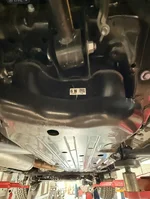
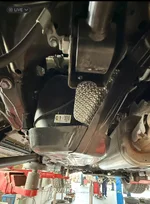
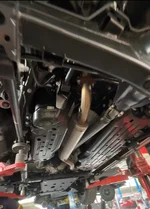
In a few years if there is a high quality auxiliary tank or replacement tank available I will buy one.
I’m not going to pretend like I’m going to be over landing this rig, frankly if I wanted to overland in the US (not rock crawl) I would look to acquire a 3/4 to 1 ton diesel pickup, either Ford or Ram for the solid front axles, and build that up because those will have sufficient payload and axle ratings to load down with a thousand plus pounds of skid plates, bumpers, lights, roof top tent, winch etc etc. Plus a 6.7L turbo diesel is not going to be especially stressed propelling it all, even on 35” or 37” E load all terrain tires; furthermore the transmissions on those trucks are already equipped with big stand alone transmission coolers to tolerate low speed off road driving and operations under continuous load.
That said a decent set of all terrains on the 18” or 20” wheels even if you stay with a P Metric tire are going to ding fuel efficiency by 1-2 MPG. We are already dealing with a small fuel tank, on top of that the fuel gauge is laughably conservative to hold fuel in reserve to keep the fuel pump submerged at all times. When we stack these up with the fact that real world speed limits and driving conditions are generally higher than the EPA test cycle, we end up with a fuel capacity that is borderline unacceptable for day to day week to week use.
On a road trip after a couple of hours someone in the vehicle wants to take a leak, get a beverage, stretch their legs etc. So stopping every 200-250 miles to take on more fuel isn’t a deal breaker, but it sure as hell can be inconvenient depending on where or when you would prefer to stop! More range gives you more options, in the middle of nowhere South Dakota where everyone is friendly and it’s pretty safe (outside of reservations) it’s maybe not as big of a deal, but there are plenty of places that it’s not advisable to bail off of the highway at 23:45 on a Saturday night to piss and get gas.
Then as mentioned there’s the issue of exploratory day trips. Sometimes they get sideways, you don’t realize how slow and rugged things will get, and your fuel economy is going to suffer. A small tank adds anxiety, limits opportunities, and generally makes things less fun.
Long Range America is working on a solution, maybe two, that will hopefully address this. One of them involves an exhaust modification, the other involves relocating the spare tire. I’m personally more interested in the side saddle auxiliary tank and the exhaust modification. It’s supposedly about 16 gallons of fuel, which would give 33.9 gallons total on board. If a guy can average 23 MPG highway, which is close to what I’ve been getting, you would have about 650 miles of highway range holding 3 gallons in reserve in each tank to keep the pumps happy. Guaranteed I will need to take a leak way way before I run through all that fuel.
Even if you’re out doing low speed wheeling and you’re getting all of 8 MPG you’d get over 220 miles out of the tanks. If that describes your use case I would suggest you better have a sat phone/starkink, lots of recovery gear, a second spare tire, tire repair equipment, air compressor, lots of water, food, camping gear, and of course appropriate clothing and footwear. That’s quite a trek, and good planning, skill, and gear are mandatory. Frankly you shouldn’t be undertaking that kind of thing solo anyway, that’s a 2-3 vehicle mutual support effort in my opinion.