11/29 UPDATES - also posted at the end of my original post
New info from vendor / me:
-Our fuel pump has an swirl pot design. I was able to confirm this elsewhere. If you're not familiar with Swirl Pots, they essentially prevent fuel pump starvation by placing the pump inside a "pot" that fills with fuel. The pump is ALWAYS submerged regardless of fuel level (unless truly empty). This prevents air in the fuel line during offroading, but in context of this conversation it also means the pump is always submerged and therefore the level of gas in the tank essentially doesn't matter from a cooling perspective. The pump is always submerged, with cool gas coming in and warm gas going out. Therefore, the legacy thinking we all grew up with that the tank has to remain 1/4 full all the time is...inaccurate. Also, you very much could run the tank down much lower than the fuel light without damaging the pump (until it goes empty...don't do that ha)
-The tank also has a built-in sump design which further reinforces fuel supply to the pump/swirl pot inlet.
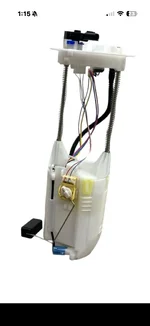
-Contrary to what was discussed previously at various points in this thread, the pump DOES have a float. It is attached to a modern potentiometer, but it very much has an external float. This can be seen in the instructional video when they remove & reinstall the pump (it's quick). (photo of our pump attached also)
-The full internal volume of the tank is 110L (just about 29 gallons), however due to cavities and venting and the like, it can be expected to "take" between 26.4 and 27.4 in every day conditions. If you could slosh it around and clear airspace you could get more. It is important to keep a headspace for thermal expansion and keeping gas out of the vapor canister and venting systems...so all tanks have a headspace for that reason (as I understand it, anyways). Also if the gas pump allows for slower filling rate you may be able to squeeze a bit more if the venting rate is the limiting factor.
-I previously reported that the Fuel Light should come on at 15L remaining (about 4 gallons). Turns out they say 15L to be conservative and prevent you from stranding yourself. It actually comes on between 15-20L (4-5.25 gal) and in my experience it came on at the high end, about 5+ gallons.
-When I say "fuel light" , it isn't clear what that means. The truck gives you a pop-up message first saying "fuel low", then the gas icon turns from white to orange (these may be simultaneous). Then the MTE hits zero and you get a "REFUEL" message. The 5+ gallon point is when the icon flips from white to orange.
Gauge & MTE accuracy:
-When I filled up (twice) the MTE reads the same as always, 302. It doesn't adjust for anything, as expected. It will always be wrong and there isn't a fixed conversion factor as you'll see from the charts.
-MPG is unaffected, as expected.
-Gauge reads 100% at full, as expected.
The thing to note is that the heights of "everything" (the pump, the top, the bottom, etc) are the same as OEM. But the new tank is wider, longer, and boxier, giving more capacity at a given fuel height. So, anything that gets measured off that float / fuel height will be "right", but the number of gallons in the tank at that point will be much larger. Anything that uses tank capacity in a calculation will be wrong. Fuel usage / MPG stays correct as it is measured via flow not volume in the tank.
I am adding some charts. I took a data point each time I completed a trip and graphed them. There are three I felt were most useful; forgive lack of effort on formatting, this is enough work as it is lol.
The takeaways are:
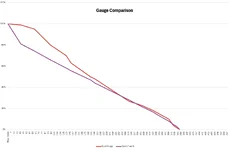
Gauge Comparison: as I think we have all experienced, the factory gauge stays "full" for a very long time before it starts to really show progress downwards. As such, the gauge overstates the fuel level until about 1/2 tank, at which point it becomes reasonably accurate. NOTE: "empty" in this case means about 5 gallons left.
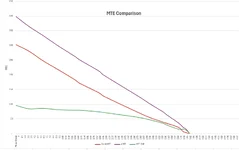
MTE Comparison: MTE is, essentially, useless as it starts way lower, and slowly and non-linearly reaches zero at the same time the gauge hits zero. Because it isn't linear, there's not simple math anyone will want to do to convert it to real miles remaining.
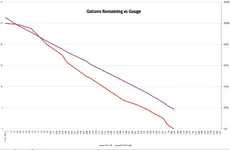
Gallons Remaining vs. Gauge: This is another version of the first chart; this is just to make it intuitive what is happening with the number of gallons in the tank, vs. the number of gallons before the fuel light comes on.
Ok, what did I learn?
-practical tank capacity is more like 26.4-27.4;
-you'll get about 21.5-22.5 burned before fuel light
-once fuel like comes on you have about 5 gallons, for me I'm happy to drive anther 40-60 without worrying about anything, as that puts you around the oem fuel light level
-if you don't want to drive past the fuel light, you're looking at give or take 440 mile range on the hwy at 20mpg, or up to around 500 with the "factory" buffer of about 2 gallons left in the tank.