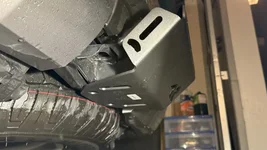
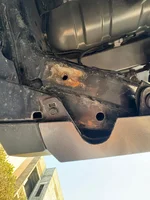
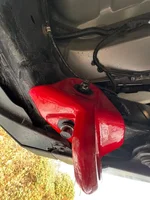
Rear recovery point options?

...There is always a risk of exceeding the frame’s permissible load, particularly with modern kinetic recovery ropes...
I think you've said this a couple times now, and every time I've read it I've thought to myself: "I thought kinetic recovery ropes were generally considered to be better in this regard, especially compared to something that does not yield (like a chain, etc.)." Is my thinking wrong in this?
 
I thought kinetic recovery ropes were generally considered to be better in this regard, especially compared to something that does not yield (like a chain, etc.)." Is my thinking wrong in this?
Hello,
Yes, a kinetic recovery can be more effective than a straight pull, but it also has some downsides. The main one is how hard it is to control.

The problem is that the energy involved goes up with the square of the speed. Double your speed and you’re dealing with roughly four times the energy. That means even a small increase in approach speed can make a huge difference in what happens at the rope.

That’s why I personally prefer a straight pull, even if it’s less “powerful.” It’s much more predictable. The force feels closely tied to engine RPM, so you have a good sense of what you’re doing and how much load you’re putting into the system.

With a kinetic recovery, a few km/h more speed can turn a gentle pull into something violent very quickly. Even if the peak force doesn’t strictly increase with the square of the speed, the jump in stored energy makes it hard to feel and control, especially in real-world conditions.
 
Using a kinetic rope eliminates the bone crushing jar that happens with a strap/rope when pulling someone out of a ditch from a muddy road where a winch is useless....... sometimes ya just gotta send it.
 
this thread has made this single vs double rear recovery point clear as mud😂
In all seriousness, I think I am gathering two would be the best way, but we do not truly have that option. We could add some half-ass bolt on second point but we could be making the situation worse if it fails. Right?? I guess I am sticking with my factor55 hitch for now and try to not get stuck.
I'm never planning to use anything but the receiver hitch while pulling someone out or when I need to be pulled from the rear. Agreement on two points (if really stuck) when being pulled from the front.
 
For the fronts, is there also agreement on whether to bother changing the OEM recovery points?

There’s info on the strength of the OEM bolts and 3rd party recovery points, but no info on the max pull weight of the OEM point itself.

Also confusing that some 3rd party aluminum points are rated 5,000-6000 pounds and others 10,000-11,000 pounds. I think steel ones are mostly 11,000 pounds.

And the rating and material for the replacement Toyota points for the Tacoma (which apparently fit the LC) aren’t specified.
 
With a kinetic recovery, a few km/h more speed can turn a gentle pull into something violent very quickly. Even if the peak force doesn’t strictly increase with the square of the speed, the jump in stored energy makes it hard to feel and control, especially in real-world conditions.
The idea behind Yankum recovery ropes is that they stretch some, before reaching max stretch, and then yank the stuck vehicle up out of the hole in the sand.. Which is exactly what they were designed to do.
 
The idea behind Yankum recovery ropes is that they stretch some, before reaching max stretch, and then yank the stuck vehicle up out of the hole in the sand.. Which is exactly what they were designed to do.


A straight pull with no slack is limited by available traction; at worst, if the recovery vehicle stalls, nothing happens. In contrast, a kinetic recovery can become unsafe when vehicle speed, rope stiffness, and mass combine to generate a peak rope force that exceeds the rating of the weakest component in the recovery system—a turning point I wouldn’t wish on anyone.
 
… In contrast, a kinetic recovery can become unsafe when vehicle speed, rope stiffness, and mass combine to generate a peak rope force that exceeds the rating of the weakest component in the recovery system—a turning point I wouldn’t wish on anyone.
I am not sure what your point is… But the Yankum Ropes company includes NO metal hooks in their recover products, to be used to connect to ‘recovery points’ on stuck vehicles, OR rescue vehicles. They even have soft shackles, made of rope, (which I included in my recovery kit order) to use to connect their kinetic ropes to recovery points on vehicles.

If you watch their videos (YouTube and social media) you will see that one of their vehicles, an ‘02 Tacoma, easily snatches one ton trucks out of the morass that they are buried in on Daytona Beach, where I grew up. Only nowadays, there is a predominance of coquina sand blown in from recent hurricanes, in some areas of the beach. The coquina sand is particularly treacherous and captures many 4 X 4’s. On some of their videos they also show jeeps with huge tires, that use flat recovery straps (NON kinetic) and cannot free the buried trucks, and/or many times even buried cars.
 
Last edited:
A straight pull with no slack is limited by available traction; at worst, if the recovery vehicle stalls, nothing happens. In contrast, a kinetic recovery can become unsafe when vehicle speed, rope stiffness, and mass combine to generate a peak rope force that exceeds the rating of the weakest component in the recovery system—a turning point I wouldn’t wish on anyone.
I've read your comments and technically you're correct, BUT.......I don't know anyone that when performing a straight pull and the pulling vehicle loses traction right away, just stops the pull. Normally they stop, back up and get a foot or two of slack, then try and "snatch" the stuck vehicle. That "snatch" transmits all the forward energy into the stuck vehicle for a very sudden and violent jerk, sometimes resulting in a broken rope or broken parts and can as you stated "can become unsafe when vehicle speed, rope stiffness, and mass combine to generate a peak rope force that exceeds the rating of the weakest component in the recovery system"

A kinetic rope can be used in a straight pull, and if needed, in a kinetic pull. I guess if you have no clue how to use a kinetic rope, one might be resistant to them. Sometimes all that's needed is a bump, sometimes it's full send. In all of them regardless of the type of rope, the weak link, IMO is the soft shackle.
 
.. In all of them regardless of the type of rope, the weak link, IMO is the soft shackle.
In ALL of the ‘Sandtow’ videos that I’ve seen, I have never seen a Yankum brand soft shackle fail. Not saying they can’t or don’t, I’ve just never seen one of Yankum’s soft shackles fail.

SandTow gets a lot more than one foot of slack in their Yankum recovery ropes when they have to snatch a one ton pickup truck resting on the frame, up out of a hole and on their way.

The metal hooks have been documented to break, as well as the ball on a tongue, causing serious injury or damage, which makes those so equipped tow straps a lot more dangerous.

EDIT: a significant kinetic recovery..
 
Last edited:
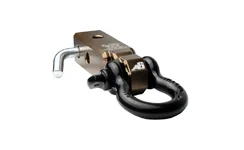
I’ve got an Agency6 hitch shackle for recovery and I also using a hitch slider for a jack point and recovery, similar to these.

IMG_3490.jpeg
 

Attachments

  • IMG_0126.webp
    IMG_0126.webp
    138.8 KB · Views: 200
  • IMG_7666.webp
    IMG_7666.webp
    19.6 KB · Views: 175
I don't know anyone that when performing a straight pull and the pulling vehicle loses traction right away, just stops the pull
Me I'm the guy who will never get one or two foot and slack. I will use the information given by the context. I'm the guy who read the manual and press the right butons. LC craw control makes miracles in straight no slack pull.
 
  • Like
Reactions: SJR


Wow, this is impressive.

At 3:43, after accelerating and releasing momentum, the stuck vehicle barely moves. Both vehicles then stop, and viewers can observe a straight-pull attempt at extremely high RPM and high spinning. Please note that a spinning tire is less effective than one with grip, which is precisely why systems like ABS exist.

Pressing the right buttons and reading the manual can be more effective than resorting to a kinetic recovery, because a Toyota in Crawl Control mode can self-recover in sand, even when bogged down to the chassis.

Finally, the icing on the cake: at 9:57, a kinetic recovery strap is attached to the control arms. The vehicle literally jumps out of the bog, and it’s reasonable to question whether that amount of energy was really necessary. Don’t forget the wheel alignment afterward.

This video demonstrates exactly my point: kinetic recoveries involve momentum and energy that are difficult to control. An please, when offroading have your car equipped with recovery points.
 
I think everyone is making valid points here. Good info on using crawl control for a tow. I never thought of that. I also think kinetic rope pulls rely on drivers who understand how to use it, and understand how to manage the energy. Same applies to the straight pull but in a different way - just understand how to apply the torque. To me both have applications and why I carry both types. Along with soft shackles for safety if things go wrong.
 
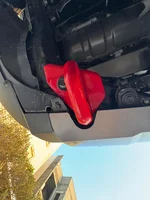
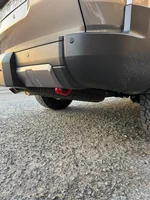
Hey I got my oem rear recovery today, used a Dremel with sanding drum to make a nice curve in the bumper to make it fit.
 

Attachments

  • Image 01.webp
    Image 01.webp
    173.9 KB · Views: 197
  • Image 02.webp
    Image 02.webp
    157.4 KB · Views: 183
  • Image 03.webp
    Image 03.webp
    211.5 KB · Views: 197
  • Image 04.webp
    Image 04.webp
    199.9 KB · Views: 206
  • Image 05.webp
    Image 05.webp
    195.8 KB · Views: 204
  • Image 06.webp
    Image 06.webp
    377.7 KB · Views: 222
Hey I got my oem rear recovery today, used a Dremel with sanding drum to make a nice curve in the bumper to make it fit.
Clean work!
 
Back
Top Bottom