panhard bar (track bar) or panhard bracket or both when doing a lift?

I have the C59-817V with IMS shocks in the rear and the truck sits about 1.6 inches higher than stock. I have not added any significant weight to the vehicle. (How are you measuring 1.75 inches higher on yours with a lower rated spring??)

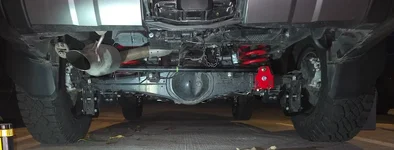
Anyways, I just installed the Dr KDSS Shorty BOTCK on the truck using the stock panhard bar. Corrected the angle from about 3.5 degrees to 0.8 degrees. Its not perfectly level now, but its much better. (i dont think it comes level from the factory anyways, to account for the potential load in the trunk. I didnt measure the angle of the bar pre lift so i dont know for sure. if anyone has that measurement, it would be a great reference). After the BOTCK install, the ride quality seems to be a better when taking bumps in the rear.

Before:
View attachment 63460


After:
View attachment 63461

And the distance from the top of the panhard bar to the frame cross member after BOTCK install is a little under 5 inches, while the distance from rear axle to bump stop is 4 inches. This means that the raised panhard bar and bracket should not contact the frame even when the suspension bottom outs.

So IMO, you dont need a new panhard bar. You just need Dr KDSS Shorty BOTCK and you should be good to go.

View attachment 63462


And regarding upper control arms, if you can get it aligned, then you dont need it. I did not need it for mine, which is lifted the same in the front and rear (~1.6 inches).
Thanks for that info! Looks like that bracket is the way to go.

I measured from hub center to bottom of fender lip prior to lift. Then again after.
 
So lots of good info and conversation on this one, and not to argue at all, but this is an easy one to get sidetracked on. I borrowed a snapshot of the photo below because it's a great view point. I have the Dr KDSS rear shorty bracket and Dobinsons panhard (redundant, just never took the bracket off after mounting the bar) and even Dr KDSS talks about angle being really important, but we shouldn't get too far down that rabbit hole. Looking at this picture, imagine the rear of the vehicle going up and down, say in your mind add a 4" lift, and the higher the vehicle goes the steeper the angle of the bar. The angle is a function of the distance between the upper mount of the frame and lower on the axle and the angle sets nothing, zero, zilch. As the axle drops and/or the vehicle is lifted, the angle increases, the upper mount is the pivot point, and the panhard pivots on the upper mount swinging the axle to the left.


Now in the same picture, imagine an adjustable panhard installed, and in this scenario there is a 3" lift. Because the mounting points are fixed and there is increased vertical distance, there is going to be an increased angle seen on the panhard, period, no way around that, you're going to achieve a level bar as the only way physically possible to do that is get the mounting points on the same plane, i.e. the same distance from the ground or frame, however you choose to visualize it. The DR KDSS bracket raises the lower mounting point and does decrease that angle and in doing so because, again, a fixed upper mounting point moves the rear axle back to the right a bit, which is in fact the entire goal here, not the angle. Back to imagining that adjustable panhard and lifted LC. Vertical distance is increased, angle of bar is increased, axle is shifted to the right. We then lengthen that adjustable bar which pushes the axle back to the right, centering the axel, and there is simply a resultant angle on the bar.

I know that was a lot of words and I apologies guys, but not once (I could have missed it) did I, do I, or have I seen in these convos anyone talking about centering the axle, taking hub to frame measurements. etc., everyone's caught up on that damn angle! lol
 

Attachments

  • 1774885583354.webp
    1774885583354.webp
    43.2 KB · Views: 112
Vertical distance is increased, angle of bar is increased, axle is shifted to the right. We then lengthen that adjustable bar which pushes the axle back to the right, centering the axel, and there is simply a resultant angle on the bar.
Did you mean "pushes the axle back to the left"?

Also, to make sure I'm reading correctly, are you saying the adjustable bar is better, or the bracket is better, or the best way to go is to get both?
 
Did you mean "pushes the axle back to the left"?

Also, to make sure I'm reading correctly, are you saying the adjustable bar is better or the bracket is better or the best way to go is to get both?
Sorry, lots of words and I was typing fast.

Any length bar will pull towards the driver's side when the body lifts up (lift or dynamically while driving), and then pushes back towards the passenger side as the body lowers back down over the axle. An adjustable bar allows for lengthening the side-to-side distance between the upper mount on the driver's side and lower mount on the passenger side. So, while the vehicle is parked and level in it's static position, the length of the bar can be adjusted to center the rear axle, which will always be in the manner of lengthening.

I orginally added the Dr KDSS Shorty which by raising that lower right mount, effectively "adds length to the bar" and provides just a bit of axle shift back to the right. When I added the adjustable bar I just never went back in and removed the Shorty bracket, but did use the bar to center my axle none the less. Which is better? Well the bar is better because it's ;ess parts and actually has the adjustability to re-center the axle.
 
So lots of good info and conversation on this one, and not to argue at all, but this is an easy one to get sidetracked on. I borrowed a snapshot of the photo below because it's a great view point. I have the Dr KDSS rear shorty bracket and Dobinsons panhard (redundant, just never took the bracket off after mounting the bar) and even Dr KDSS talks about angle being really important, but we shouldn't get too far down that rabbit hole. Looking at this picture, imagine the rear of the vehicle going up and down, say in your mind add a 4" lift, and the higher the vehicle goes the steeper the angle of the bar. The angle is a function of the distance between the upper mount of the frame and lower on the axle and the angle sets nothing, zero, zilch. As the axle drops and/or the vehicle is lifted, the angle increases, the upper mount is the pivot point, and the panhard pivots on the upper mount swinging the axle to the left.

Now in the same picture, imagine an adjustable panhard installed, and in this scenario there is a 3" lift. Because the mounting points are fixed and there is increased vertical distance, there is going to be an increased angle seen on the panhard, period, no way around that, you're going to achieve a level bar as the only way physically possible to do that is get the mounting points on the same plane, i.e. the same distance from the ground or frame, however you choose to visualize it. The DR KDSS bracket raises the lower mounting point and does decrease that angle and in doing so because, again, a fixed upper mounting point moves the rear axle back to the right a bit, which is in fact the entire goal here, not the angle. Back to imagining that adjustable panhard and lifted LC. Vertical distance is increased, angle of bar is increased, axle is shifted to the right. We then lengthen that adjustable bar which pushes the axle back to the right, centering the axel, and there is simply a resultant angle on the bar.

I know that was a lot of words and I apologies guys, but not once (I could have missed it) did I, do I, or have I seen in these convos anyone talking about centering the axle, taking hub to frame measurements. etc., everyone's caught up on that damn angle! lol
I actually completely disagree with on this.

The Dr KDSS bracket should both correct your bar angle AND recenter your axle, depending on your lift height and how high the bracket raises the mount point.

In my case, I have 1.6 inch lift, with OEM track bar, and the bracket raises the mounting point by about 2 inches. So now the axle mounting point is about .5 inches higher than stock, which makes it more level, though not completely level bc I don't think it comes level from the factory. Having a level track bar reduces the left and right movement when the suspension travels up and down. There's a lot of videos on youtube illustrating this if you need a visual (this one is a really good one: )

Regarding centering the axle, this is less of an issue with a smaller lift. If you go for a larger lift, then you might need both the bracket and a longer panhard to find a middle ground between a level bar and a centered axle, without making the bar contact the frame cross member at full suspension compression.

TLDR, imagine the bracket raises the mounting point by 2 inches, and you have a 2 inch lift. With the OEM track bar, the bracket would both:
1. Level your track bar at the OEM level
2. Center your axle to what is was from the factory.
It's just basic geometry.
 
Last edited:
To add on, there's not much mention of centering the axle because it's a given if you raise the track bar mounting point the same distance as your lift height.

(The Dr. KDSS shorty bracket raises the mounting point by 5.5cm to be exact)
 
I actually completely disagree with on this.

The Dr KDSS bracket should both correct your bar angle AND recenter your axle, depending on your lift height and how high the bracket raises the mount point.

In my case, I have 1.6 inch lift, with OEM track bar, and the bracket raises the mounting point by about 2 inches. So now the axle mounting point is about .5 inches higher than stock, which makes it more level, though not completely level bc I don't think it comes level from the factory. Having a level track bar reduces the left and right movement when the suspension travels up and down. There's a lot of videos on youtube illustrating this if you need a visual.

Regarding centering the axle, this is less of an issue with a smaller lift. If you go for a larger lift, then you might need both the bracket and a longer panhard to find a middle ground between a level bar and a centered axle, without making the bar contact the frame cross member at full suspension compression.

TLDR, imagine the bracket raises the mounting point by 2 inches, and you have a 2 inch lift. With the OEM track bar, the bracket would both:
1. Level your track bar at the OEM level
2. Center your axle to what is was from the factory.
It's just basic geometry.
I don't disagree with the L/R movement of the axle while driving etc., and of course, if you lift 2" inches and add a 2" bracket, then your geometry is the same. However the higher that bracket, the longer of a leverage arm it becomes and ultimately it sees more stress and flex etc. I was simply making a point that angle does not drive the centering of the axle. In my opinion having a centered axle is more important than an axle that might see 1/2" or so of L/R movement, which the suspension is designed to do anyway.
 
I don't disagree with the L/R movement of the axle while driving etc., and of course, if you lift 2" inches and add a 2" bracket, then your geometry is the same. However the higher that bracket, the longer of a leverage arm it becomes and ultimately it sees more stress and flex etc. I was simply making a point that angle does not drive the centering of the axle. In my opinion having a centered axle is more important than an axle that might see 1/2" or so of L/R movement, which the suspension is designed to do anyway.
It just seems like you are putting a lot of emphasis on a longer track bar being better than a bracket to raise the mounting point. It depends on the lift height and what tradeoffs you want to make.

If you can get both centered axle AND more leveled track bar, why not go that route? A bracket of the correct height would be the best of both worlds. The DR KDSS bracket seems to be durable historically but time will tell.

@corywf If your lift is about 1.75 inches, I would recommend the bracket. Save your money and use the OEM track bar. The bracket will correct both issues. But to make sure, you can measure the height difference between the two bolt holes of the track bar to see if the 5.5cm correction that the Dr KDSS shorty bracket gives is sufficient. Dont just buy stuff that random people like me on the internet suggest. Understand what it does first and how it affects your rig before buying. :)
 
Supporting Vendors View all โ†’
M&R Automotive
Back
Top Bottom