Gas cans on roof

I'm not opposed to spending the money, but it always feels like a game of navigating the oVeRgLamPinG InDuStRiAl CoMplEX and understanding what's truly value-adding. Browsing the internet you get both ends -- "why waste your money Temu is fine" and "think of all the children you'll murder by not having the correct set up". I'm starting to lean towards proper cross bars (and properly mounted accessories) as I can think of other use cases.

I don't know what I was thinking with filling up when leaving home. Near the trail clearly makes sense.


I'm not truly getting out there, I almost certainly do not need extra fuel. The problem is I don't know what I don't know. Maybe I want to crawl around the mountains for longer than estimated because I found a cool trail (this happened to me last trip). Maybe I get stuck and burn a lot of time trying to get out. Maybe I misjudge the weather and want to run the truck for heat or AC. Maybe I'm really bad at math.

I don't use my spare tire either and yet it's still attached, adding weight.
Yeah that’s a good summary of the consumer and industry. You gotta figure out what is valid, what is noise, and what you need when opinions are strong and the market is decidedly saturated with junk and excess.

Having extra fuel isn’t a bad idea. I’ve carried rotos and jerry cans on all of my TJs at one point or another. 400 miles shrinks down to 300 when going low and slow on trail and your mpg drops to the low teens. I do not think it is an invalid concern at all. I do think this is one of those instances where the market has quality options, but none of those options fit in the budget category. You need to spend good money to safely address the range issue.
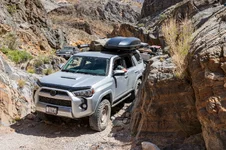
 
This has been my exact thinking, and it's not even based on experience. I'm planning a DV trip soon...hopefully
Do you take a jerry can to DV with you? I feel like you can fill up prior to entrance and during mid trip.
Death Valley is a special place, you will very much enjoy it. There is fuel at Stovepipe, Panamint and Furnace Creek. I usually take a single 5 gallon jerry of fuel and lots of water. Last trip I ended up giving the fuel to someone in a Toyota T-100 that was on fumes and in a full panic, and not in a very remote location.

Death Valley is tricky because 5 miles in DV can be everything from a wide open graded road at 40 mph to a half day event like Steel Pass.
 

Attachments

  • 1Z4A5833.webp
    1Z4A5833.webp
    564.5 KB · Views: 43
Last edited:
the only reason TO carry fuel is for when things don't go according to plan and there are no other reasonable options available. My last trip had a 245 mile leg where fuel was unavailable. I was not familiar enough with my somewhat new LC's off-road appetite for fuel under highly varied driving conditions to convince myself that I had enough safety margin in the tank so I set up for and carried 4 additional gallons (I'd estimate that this set me back $400 570 the way I mounted- likely overbuilt but robust). One additional supporting reason for carrying fuel was that there were two vehicles on this trip and the other driver also felt the distance required was near his range limit.

Since you're all dying to know the results... I did navigate the entire distance without transferring the fuel. The last 50 or so miles were on paved 2 lane, tires were aired up, and represented consumption of the last quarter-ish tank. It appeared to me as I came off the last forest service road and aired up from 25 to 50 psi that I could make it on pavement and I wanted to know so I went for it. I got to the gas station showing 4 miles to empty, pulled the containers off the roof and put their contents into the tank, replaced the containers up top, and filled the remainder of the tank and took off

Edit: #1 double checked and changed cost from 400 to 570; #2 added air-up detail
 
Last edited:
hmmmm just drove home 373 miles again on Monday...cuse me stopped at Costco at 360 miles...No problem. Did 80 in 70 zones and 75 in 65 zones....no range problems experienced.............still had 1.5-?+++gallons left + whatever secret handshake extra volume is left at zero range........Gauge indicated 21.7 mpg........(21.7x17.9 says 388 miles). Point i keep making is these tanks are NOT too small. 350 -400 mile range exceeds MANY vehicles, SUVs etc.......

When someone pulls a stock tank, I'd love to know what it really holds when filled 100% (for that emergency trip). Unlike our EV folks that get a relatively accurate % remaining number that roughly correlates to miles of range left, we are in the stone ages with gas tanks and REAL accurate gauges, etc. Many people here have driven x miles past zero range left.........anyone care to chime in how many miles they stretched it esp if testing and carrying fuel for the true out of gas test? If the zealots in the room that say she is 100% at first click are to be believed, meaning 17.9 gallons at 1st click (again prove it), and I have put 2.1 more gallons in with filling to the neck..........that would indicate in a pinch you probably have 20 gallons.......(prove me wrong). Anybody that has ever gassed a car at a track event or any other kind of manual fill knows you fill till you hear it coming up the neck and stop.........if you hear it in time.........I have NEVER had a track guy lose a charcoal canister....leaving it parked stuffed for a week or month, not a great idea. Fill and go, Nah.........never gonna happen.

One of you guys in this thread, I believe, installed the bigger tank. Do us all a favor and see how much the stock unit REALLY holds please! That could put this entire ongoing fuel shortage paranoia to rest.
I did tank swap on a Tundra. There is approx 2.5G bowl that the fuel pump sits in so it always has fuel supply no matter the pitch/AOA, & also keeps pump ‘wet’ used to cool the pump. I used an extractor to pump the Tundra tank down to reduce weight doing the install & still had +3G gas in fuel pump well. Strange feature while doing the mod caught me off guard is that there is no fuel filter on Tundra or LC, they use the fuel pump’s intake screen. Strange.

The tank capacity is the tank capacity. Sitting there idling it will consume nearly every drop of gas until it runs out. The fuel gauge works off a potentiometer located on the fuel pump & low fuel warning light works off that. The tank meter swing is the physical amount of fuel in the tank.

The Range & DTE are a separate code calculating MPG, fuel level, miles traveled. My tundra still thinks on DTE it has a 22G tank & does calculations for range & DTE off the smaller hard coded tank size. Meanwhile when DTE says 0 range the fuel tank gauge level still shows less than 1/3 tank remaining. It’s just math. This calculation can get even more challenging by the number drivers changing tire sizes that also effects DTE.

 
Death Valley is a special place, you will very much enjoy it. There is fuel at Stovepipe, Panamint and Furnace Creek. I usually take a single 5 gallon jerry of fuel and lots of water. Last trip I ended up giving the fuel to someone in a Toyota T-100 that was on fumes and in a full panic, and not in a very remote location.

Death Valley is tricky because 5 miles in DV can be everything from a wide open graded road at 40 mph to a half day event like Steel Pass.
Have you taken your LC250 through steel pass?
 
I'm not opposed to spending the money, but it always feels like a game of navigating the oVeRgLamPinG InDuStRiAl CoMplEX and understanding what's truly value-adding. Browsing the internet you get both ends -- "why waste your money Temu is fine" and "think of all the children you'll murder by not having the correct set up". I'm starting to lean towards proper cross bars (and properly mounted accessories) as I can think of other use cases.

I don't know what I was thinking with filling up when leaving home. Near the trail clearly makes sense.


I'm not truly getting out there, I almost certainly do not need extra fuel. The problem is I don't know what I don't know. Maybe I want to crawl around the mountains for longer than estimated because I found a cool trail (this happened to me last trip). Maybe I get stuck and burn a lot of time trying to get out. Maybe I misjudge the weather and want to run the truck for heat or AC. Maybe I'm really bad at math.

I don't use my spare tire either and yet it's still attached, adding weight.
My suggestion......... visit your local welding shop and get a quote for making a simple 2 can receiver hitch carrier.

Jerry can Tilt mount.webp
Jerry can mount 1.webp
 
Last edited:
Carrying fuel off road shouldn’t be an issue, except for the dilemma of how to physically carry it while off-roading - roof top, hitch-mount, window molle, etc.

Important consideration is to not carry supplemental fuel when you don’t need it. Recommend the highway trip there/back the supplemental cans/tanks remain empty. Fill them right before you go off roading. Don’t need to carry the extra weight & added risks transiting across the country.

Straight up I’m speaking heresy because as a pilot you never have enough fuel…. Except sometimes in an emergency we can’t land with the same weight we took off with, as the landing forces are different on the airframe.
I say that as a consideration when your LC is getting jostled around offroad. I start questioning how much trust do I really have in the weakest link - like roof mounted riv-nuts & T-nut adapters.
 
That has tons of appeal and makes venting/using the fuel much easier. Devil's advocate-wise, it's far more likely to get rear-ended than to roll your vehicle 😎
 
Have you taken your LC250 through steel pass?
Not yet, but I will soon enough. I do not foresee any issues. I have done it in a 5th gen towing a trailer and in a FJ-62. My biggest concern entering Steel Pass is what is in front of me. I have pleaded with a sprinter van driver to turn around and barely gotten them to agree. Lippencott is also a roll of the dice, I would not want to back up on either of those trails. You should be fine with a good spotter and some patience.
 
That has tons of appeal and makes venting/using the fuel much easier. Devil's advocate-wise, it's far more likely to get rear-ended than to roll your vehicle 😎
True, but I've never been rear ended, ever. I have been the recipient of flying objects smashing the windshield and top mounted luggage carriers tho'
 
Wow! Not had that experience, knock wood!

Have been hit from behind as well been in a vehicle that rolled and stayed upside down- None of it's good with respect to fuel on board, especially when it's outside the relative safety of frame rails and axles
 
I wouldn’t worry about 40lbs on the roof. My biggest concern would be the “unique” vented cap. What will they do full while driving and gas sloshing around. I would test before going on long trip.
 
Biggest worry for me carrying gas is that it leaks onto paint. I've tried to find a simple hitch mount for 1 steel jerry can, but found nothing worth buying. Looks like im making my own. If i get rear ended, the one hitting me will get the worst of it.
 
This was a big worry for me too. I saw advice elsewhere here in the forum to "bring a web wrench" to ensure a seal. Note that RotopaX states that the tanks should be burped every 1K feet or 10F. I tried not following instructions as usual and found the Gen 2 tanks to seal perfectly with reasonable hand tightening for +/-2500ish feet @ 4000 and +/-25F @75. My tanks were mounted horizontally underneath traction boards (a shade and some sheltering from stuff from above as well as more aerodynamic) and did not leak at all.
 
This was a big worry for me too. I saw advice elsewhere here in the forum to "bring a web wrench" to ensure a seal. Note that RotopaX states that the tanks should be burped every 1K feet or 10F. I tried not following instructions as usual and found the Gen 2 tanks to seal perfectly with reasonable hand tightening for +/-2500ish feet @ 4000 and +/-25F @75. My tanks were mounted horizontally underneath traction boards (a shade and some sheltering from stuff from above as well as more aerodynamic) and did not leak at all.
If tanks are mounted horizontal, how do you burp them without spillage? Unmount and turn vertical?
 
Unmount and stand up...pita but what I chose for a more protected and aerodynamic stance.

Many of my off-road trips involve a cross country drive to get there, so to speak. I didn't want the containers to be inside at all originally and knew the majority of the time they'd be empty, space sucking pigs and probably stink, thus the mounting choice. (Having found out how well they seal, I might reconsider having empty containers in the cabin if needed now). Again, the majority of time the tanks were empty; the five or six days they had fuel in them continuously, I checked the caps essentially every stop and upon waking looking for leaking gas and never found any. The temperature and altitude range stated above are my best estimate of the data, I.e.- filling the containers in Salmon, north to Conner and then to Grangeville via Magruder Corridor without venting anywhere in between.

Edit: I SURE DO WISH SOMEBODY MADE A MOLLE PANEL FOR THE OEM RACK!!! If I was redoing it all now and still felt I could carry the cans inside, I'd look hard for a twin vertical roof mount over the way I did it. The way it's done is better in brushy low branchy areas though
 
Last edited:
I did tank swap on a Tundra. There is approx 2.5G bowl that the fuel pump sits in so it always has fuel supply no matter the pitch/AOA, & also keeps pump ‘wet’ used to cool the pump. I used an extractor to pump the Tundra tank down to reduce weight doing the install & still had +3G gas in fuel pump well. Strange feature while doing the mod caught me off guard is that there is no fuel filter on Tundra or LC, they use the fuel pump’s intake screen. Strange.

The tank capacity is the tank capacity. Sitting there idling it will consume nearly every drop of gas until it runs out. The fuel gauge works off a potentiometer located on the fuel pump & low fuel warning light works off that. The tank meter swing is the physical amount of fuel in the tank.

The Range & DTE are a separate code calculating MPG, fuel level, miles traveled. My tundra still thinks on DTE it has a 22G tank & does calculations for range & DTE off the smaller hard coded tank size. Meanwhile when DTE says 0 range the fuel tank gauge level still shows less than 1/3 tank remaining. It’s just math. This calculation can get even more challenging by the number drivers changing tire sizes that also effects DTE.

Fantastic explanation!

I've read some of your other posts and you have very well grounded, technical, explanations, which I appreciate

Quick question, but slightly off topic. Could you elaborate on the effect of tire size (specifically bigger) on DTE and MPG. I've poked around online for a way to calculate the difference, but thought you might have some insight. It's challenging to calculate because the odometer is off too I assume, so a hand calculation wouldn't work.
 
Fantastic explanation!

I've read some of your other posts and you have very well grounded, technical, explanations, which I appreciate

Quick question, but slightly off topic. Could you elaborate on the effect of tire size (specifically bigger) on DTE and MPG. I've poked around online for a way to calculate the difference, but thought you might have some insight. It's challenging to calculate because the odometer is off too I assume, so a hand calculation wouldn't work.
Appreciate the comment - You can pick up a lot of useless stuff waiting around in pilot lounges!

DTE depends on calculating remaining fuel left in tank, fuel rate being used/consumed, past driving behavior, & distance traveled. So far from simple. On newer Ford & GM vehicles owners can visit a dealer & can get a flash to their ECU to compensate for moderate changes to tire size though the OBDII port. Toyota code doesn’t make it that easy. I don’t know of an easy calculation to correct.

There’s some good websites that show the delta between the starting tire size & new tire dimensions. Traveling same distance, a larger tire is going to spin slower rpm providing a shorter distance on the odometer & effecting true distance, mpg affecting DTE.

IMG_1661.webp
ğ
 
Last edited:
I did tank swap on a Tundra. There is approx 2.5G bowl that the fuel pump sits in so it always has fuel supply no matter the pitch/AOA, & also keeps pump ‘wet’ used to cool the pump. I used an extractor to pump the Tundra tank down to reduce weight doing the install & still had +3G gas in fuel pump well. Strange feature while doing the mod caught me off guard is that there is no fuel filter on Tundra or LC, they use the fuel pump’s intake screen. Strange.

The tank capacity is the tank capacity. Sitting there idling it will consume nearly every drop of gas until it runs out. The fuel gauge works off a potentiometer located on the fuel pump & low fuel warning light works off that. The tank meter swing is the physical amount of fuel in the tank.

The Range & DTE are a separate code calculating MPG, fuel level, miles traveled. My tundra still thinks on DTE it has a 22G tank & does calculations for range & DTE off the smaller hard coded tank size. Meanwhile when DTE says 0 range the fuel tank gauge level still shows less than 1/3 tank remaining. It’s just math. This calculation can get even more challenging by the number drivers changing tire sizes that also effects DTE.

So translation I think I get here is we have a 17.9 gallon fill on the tank but in addition to this there is always ~2+gallons in that bowl so that means ~20 gallon capacity assuming it is really full at first shutoff click as so many advocate. Hmmm
or
The capacity is 17.9 gallons including the 2gallons in that fuel pump bowl. hmmmm totally different.
Guess the only variant to learn about is true capacity from dry (dead empty) to 1st click, then stuffed to the neck. Is that 17.9, 20, or may closer to 21-22?????????? I have rubeen able to add n range down to near zero and even with my "FULL" (meaning topped off) have not yet been able to add more than about 16.9-17 gallons which eqautes to~18.7 mpg .....I don't want to run it dry but at the same time, I'd like to know the true facts......this is something EVs are doing in a vastly superior fashion. Most EVs I have seen tested...0% means within 10miles of DEAD! Why good to know, I get being in the wilderness, but in reallife in Maine, its zero outside and you are in middle of a major snowstorm...It s now 11:00 because you got stuck in an accident for 2 hrs and all the gas stations are closed for the night for that last 50 miles. Lets assume the displayed mpg is actually pretty accurate ( and I'd say easily within 1 mpg, maybe .5), then I read 0 miles range left at 20 mpg, am I dead within 10 miles or is there really 2 more gallons++ in there to get the family and dogs safely to the house assuming I topped up immediately before I left to ensure max possible range knowing weather was bad, but never expecting an accident. This is real life stuff so the you should have stopped to refill folks ........nothing in life is perfect...and the power was out so station was closed anyway.......or my wife got lost once ...I went to start her Ascender next morning and it was dead empty!

The topic is about fuel......knowing the max amount our rig's tank can carry might allay a lot of concerns. Filler neck aside (probably a quart or so max)
 
Last edited:
So translation I think I get here is we have a 17.9 gallon fill on the tank but in addition to this there is always ~2+gallons in that bowl so that means ~20 gallon capacity assuming it is really full at first shutoff click as so many advocate. Hmmm
or
The capacity is 17.9 gallons including the 2gallons in that fuel pump bowl. hmmmm totally different.
Guess the only variant to learn about is true capacity from dry (dead empty) to 1st click, then stuffed to the neck. Is that 17.9, 20, or may closer to 21-22?????????? I have rubeen able to add n range down to near zero and even with my "FULL" (meaning topped off) have not yet been able to add more than about 16.9-17 gallons which eqautes to~18.7 mpg .....I don't want to run it dry but at the same time, I'd like to know the true facts......this is something EVs are doing in a vastly superior fashion. Most EVs I have seen tested...0% means within 10miles of DEAD! Why good to know, I get being in the wilderness, but in reallife in Maine, its zero outside and you are in middle of a major snowstorm...It s now 11:00 because you got stuck in an accident for 2 hrs and all the gas stations are closed for the night for that last 50 miles. Lets assume the displayed mpg is actually pretty accurate ( and I'd say easily within 1 mpg, maybe .5), then I read 0 miles range left at 20 mpg, am I dead within 10 miles or is there really 2 more gallons++ in there to get the family and dogs safely to the house assuming I topped up immediately before I left to ensure max possible range knowing weather was bad, but never expecting an accident. This is real life stuff so the you should have stopped to refill folks ........nothing in life is perfect...and the power was out so station was closed anyway.......or my wife got lost once ...I went to start her Ascender next morning and it was dead empty!

The topic is about fuel
Good point, it never pays to run the the tank close to empty unless it's an emergency. I like to travel overnight, and as you said, finding gas can be difficult. What's left after 0 range is good to know, but if I'm in that situation, ive already made some poor decisions. This is also my argument for claiming an undersized tank in LC. I see usable safe range from full to 1/4 tank. You never know when you'll be stuck in stopped traffic for hours, or stuck somewhere in conditions needing A/c or heat for extended periods.
I also dont like a car in the dreway with low fuel, might need to race to ER, or Armageddon event etc.
 
Supporting Vendors View all →
Back
Top Bottom