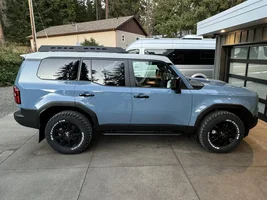
Honest LC250 review that goes into more technical details & why Toyota missed the mark on LC250

These visual comparisons seem too simplistic to me. In mechanical engineering, bigger is not always better.

Added unnecessary weight has many negative factors that affect thermal, material, and stress dynamics. Not to mention higher level goals for lower cost and better fuel efficiency.

So there is always the perpetual evolution of designs to achieve the same with less. It may be counter intuitive, but that process is also highly correlated with greater reliability and lower failure rates because the products get better over time.
 
This thread is not like the rest of the threads. This one starts with an off-road perspective that prioritizes off-road capability and durability over fuel mileage and cost. The tripod design certainly works for most street vehicles and stock SUV's.
 
I understand. My point is that weight is a killer in "offroad" scenarios. Over engineered parts actually cause higher failure rates in those environments.

Perhaps this group of engineers cut too many corners with the tripod design or maybe they looked at a lot of data and concluded it will actually be more durable.

Only time will tell. If you scale a mouse up to a bigger design it becomes an elephant, not necessarily a stronger mouse. 😀
 
I completely understand the effects of weight on an off-road vehicle. But I am for over-engineered parts, where it counts. The GX550 has several "over engineered" parts vs the 250 yet, overall, it weighs about the same. The 250 chose fuel efficiency over durability. It's better but not much better unless you are really trying to hyper mile it.
 
I completely understand the effects of weight on an off-road vehicle. But I am for over-engineered parts, where it counts. The GX550 has several "over engineered" parts vs the 250 yet, overall, it weighs about the same. The 250 chose fuel efficiency over durability. It's better but not much better unless you are really trying to hyper mile it.

The LC250 hybrid isn’t engineered for fuel efficiency—it’s engineered to mimic a diesel, which is why Toyota specifies this setup across the world for serious off-road use. Diesels (and now the hybrid) deliver instant low-end torque and smooth power, exactly what you need off-road. If the twin-turbo V6 were the better off-road engine, that’s what Toyota would be putting in global markets—but they don’t, because that motor is tuned for on-road speed and highway performance. The hybrid’s low end torque curve gives it a clear advantage in technical terrain, and its smoother delivery also reduces drivetrain stress, making it both more capable and more durable over the long run.
 
Are you talking about me? I only give facts and/or experience. Look at the pic, this is an inner tripod joint (ie LC250). On the right is the inner GX550 joint (type). Sometimes called a double offset. Has the same axial motion as the tripod but more angularity. One is obviously cheaper than the other.

View attachment 45655
A tripod joint is stronger than a rzeppa joint of same size, or in other words, a rzeppa joint of equal strength is larger and heavier than tripod joint. So I guess what this image is not showing what you intended to point out.
 
  • Like
Reactions: SJR
The LC250 hybrid isn’t engineered for fuel efficiency—it’s engineered to mimic a diesel, which is why Toyota specifies this setup across the world for serious off-road use. Diesels (and now the hybrid) deliver instant low-end torque and smooth power, exactly what you need off-road. If the twin-turbo V6 were the better off-road engine, that’s what Toyota would be putting in global markets—but they don’t, because that motor is tuned for on-road speed and highway performance. The hybrid’s low end torque curve gives it a clear advantage in technical terrain, and its smoother delivery also reduces drivetrain stress, making it both more capable and more durable over the long run.
You have, in your mind, what you think is the "ideal" engine for everything off-road. But there isn't an ideal engine for all types of off-road. You said "serious" so let's go with that. How many trophy trucks run on diesel? How many KOH trucks run on diesel? How many rock crawling trucks run on diesel? How many sand dune trucks run on diesel? Not many.

Okay, how many overland trucks run on diesel? A lot. They do that especially well due to low end grunt and fuel mileage. These aren't serious off-roaders, they just kinda chug along but they do that very well. Serious overlanders? Perhaps. For technical wheeling, I'd go with gearing. Small engines with 100-150:1 crawl ratios do very well. Both diesel and hybrid mean extra weight.... not desirable for technical wheeling. Speaking of global market, despite what you think, most Land Cruisers sold in the world are gas, not diesel.

A tripod joint is stronger than a rzeppa joint of same size, or in other words, a rzeppa joint of equal strength is larger and heavier than tripod joint. So I guess what this image is not showing what you intended to point out.
For more serious off-road, you want CV's that can handle greater angularity. The tripod joint will certainly fail when used outside stock boundaries.

The image shows the double offset joint/ modified Rzeppa can indeed take axial motion, which your googling said it couldn't. Sorry you didn't get it.
 
I am quickly learning that the off road community is as and even more OCD with their technical specs than the racing community. Amused. Let the 10% enjoy themselves..same as my side of the aisle.
 
Last edited:
You have, in your mind, what you think is the "ideal" engine for everything off-road. But there isn't an ideal engine for all types of off-road. You said "serious" so let's go with that. How many trophy trucks run on diesel? How many KOH trucks run on diesel? How many rock crawling trucks run on diesel? How many sand dune trucks run on diesel? Not many.

Okay, how many overland trucks run on diesel? A lot. They do that especially well due to low end grunt and fuel mileage. These aren't serious off-roaders, they just kinda chug along but they do that very well. Serious overlanders? Perhaps. For technical wheeling, I'd go with gearing. Small engines with 100-150:1 crawl ratios do very well. Both diesel and hybrid mean extra weight.... not desirable for technical wheeling. Speaking of global market, despite what you think, most Land Cruisers sold in the world are gas, not diesel.
Pointing to trophy trucks, KOH rigs, dune buggies, and rock crawlers as ideal examples is like saying NASCAR should defines what the average commuter needs in a car. Those motorsport builds are entertainment — they represent an irrelevant fraction of how 4x4s are actually used worldwide.


The overwhelming majority of off-highway use isn’t racing. It’s overlanding, expedition travel, agriculture, mining, forestry, defense, humanitarian, and utility work. That’s the “serious” side of off-road, and that’s exactly why Toyota and every other global manufacturer overwhelmingly spec diesel for those applications: torque, range, and global fuel availability matter far more than peak horsepower.


And let’s be clear: the claim that “most Land Cruisers sold in the world are gas, not diesel” is flat-out wrong. In the U.S. (where diesels aren’t offered) and a few luxury trims elsewhere, yes, you see more gas engines. But step outside that bubble — Africa, Australia, the Middle East, Asia, Europe — the majority of Land Cruiser sales are diesel. Globally, diesel is the primary workhorse spec, and has been for decades.

If high-revving gas motors were truly the better global off-road solution, they’d be what Toyota sells everywhere. They aren’t — because the real world has already answered that question.
 
Pointing to trophy trucks, KOH rigs, dune buggies, and rock crawlers as ideal examples is like saying NASCAR should defines what the average commuter needs in a car. Those motorsport builds are entertainment — they represent an irrelevant fraction of how 4x4s are actually used worldwide.


The overwhelming majority of off-highway use isn’t racing. It’s overlanding, expedition travel, agriculture, mining, forestry, defense, humanitarian, and utility work. That’s the “serious” side of off-road, and that’s exactly why Toyota and every other global manufacturer overwhelmingly spec diesel for those applications: torque, range, and global fuel availability matter far more than peak horsepower.


And let’s be clear: the claim that “most Land Cruisers sold in the world are gas, not diesel” is flat-out wrong. In the U.S. (where diesels aren’t offered) and a few luxury trims elsewhere, yes, you see more gas engines. But step outside that bubble — Africa, Australia, the Middle East, Asia, Europe — the majority of Land Cruiser sales are diesel. Globally, diesel is the primary workhorse spec, and has been for decades.

If high-revving gas motors were truly the better global off-road solution, they’d be what Toyota sells everywhere. They aren’t — because the real world has already answered that question.
What does lc300 have? 4 cyl hybrid ?
 
Pointing to trophy trucks, KOH rigs, dune buggies, and rock crawlers as ideal examples is like saying NASCAR should defines what the average commuter needs in a car. Those motorsport builds are entertainment — they represent an irrelevant fraction of how 4x4s are actually used worldwide.


The overwhelming majority of off-highway use isn’t racing. It’s overlanding, expedition travel, agriculture, mining, forestry, defense, humanitarian, and utility work. That’s the “serious” side of off-road, and that’s exactly why Toyota and every other global manufacturer overwhelmingly spec diesel for those applications: torque, range, and global fuel availability matter far more than peak horsepower.


And let’s be clear: the claim that “most Land Cruisers sold in the world are gas, not diesel” is flat-out wrong. In the U.S. (where diesels aren’t offered) and a few luxury trims elsewhere, yes, you see more gas engines. But step outside that bubble — Africa, Australia, the Middle East, Asia, Europe — the majority of Land Cruiser sales are diesel. Globally, diesel is the primary workhorse spec, and has been for decades.

If high-revving gas motors were truly the better global off-road solution, they’d be what Toyota sells everywhere. They aren’t — because the real world has already answered that question.
You’ll never get through to them, even if you are clearly correct. They just want to argue and troll.
 
For more serious off-road, you want CV's that can handle greater angularity. The tripod joint will certainly fail when used outside stock boundaries.

The image shows the double offset joint/ modified Rzeppa can indeed take axial motion, which your googling said it couldn't. Sorry you didn't get it.
For serious off-roading, you wouldn't use a GX550 since those paths don't lead to a mall parking lot.

Angularity is fine with a tripod joint on stock suspension, it will only become an issue if you install a cheap lift kit and keep the same that stretches it out. Installing modifying the suspension accordingly is still significantly cheaper than getting an GX550

Double offset Rzeppa joint still doesn't allow same level of axial motion as tripod joint, and needs to be even larger and heavier to have equivalent strength. Plus, if the socket gets contaminated, wear itself out very rapidly. So your off-road adventure is as reliable as the rubber boot on the joint. But again, not many obstacles on a mall parking lot can tear a rubber boot, so it may be fine.
 
  • Like
Reactions: SJR
The vast majority have a diesel as do the majority of 70 series and majority of lc250.
Talking about the gas variant . Why did Toyota put the v6 in the flagship ? They should have put the superior 4cyl setup
 
Talking about the gas variant . Why did Toyota put the v6 in the flagship ? They should have put the superior 4cyl setup
Technically the V6 hybrid is their flagship powertrain.
 
Pointing to trophy trucks, KOH rigs, dune buggies, and rock crawlers as ideal examples is like saying NASCAR should defines what the average commuter needs in a car. Those motorsport builds are entertainment — they represent an irrelevant fraction of how 4x4s are actually used worldwide.


The overwhelming majority of off-highway use isn’t racing. It’s overlanding, expedition travel, agriculture, mining, forestry, defense, humanitarian, and utility work. That’s the “serious” side of off-road, and that’s exactly why Toyota and every other global manufacturer overwhelmingly spec diesel for those applications: torque, range, and global fuel availability matter far more than peak horsepower.


And let’s be clear: the claim that “most Land Cruisers sold in the world are gas, not diesel” is flat-out wrong. In the U.S. (where diesels aren’t offered) and a few luxury trims elsewhere, yes, you see more gas engines. But step outside that bubble — Africa, Australia, the Middle East, Asia, Europe — the majority of Land Cruiser sales are diesel. Globally, diesel is the primary workhorse spec, and has been for decades.

If high-revving gas motors were truly the better global off-road solution, they’d be what Toyota sells everywhere. They aren’t — because the real world has already answered that question.
My point is, those motorsports can choose any engine they want but few choose a diesel. You don't have to drive 10/10 to appreciate a petrol V8 or TTV6. I'm in CA and we have all types of terrain, sand dunes, deserts, rocks.... larger rocks, mountains, snow. Contrary to what you think, the turbo diesel is not the ideal engine for everything off road. But it does overlanding and towing especially well.

As far as gas vs diesel, you are claiming the vast majority of LC's sold outside the US are diesel, right? What is vast majority to you.... 85% or more? Toyota doesn't reveal those numbers but you can get a ballpark estimate by searching used car ads. The Middle East region dominates worldwide sales of Land Cruisers for the past few decades.
1756060813677.webp


Search www.dubicars.com or any other major used car listings. Search all Land Cruisers, filter Petrol and then filter Diesel. Out of 1831 Land Cruisers, it shows 32% diesel and 68% Petrol. Japan and Latin America favor petrol about the same. Just those estimates alone say you won't nearly achieve "vast majority." What are your figures?

Do you know what outsells the LC300 in the UAE by a huge margin? The Nissan Patrol. And the Patrol ONLY comes in Gas/Petrol. No diesel option for at least 15 years. Check those facts.

the-nissan-patrol-is-the-most-sold-car-in-the-uae-v0-7d82s2wkebke1.jpeg copy.webp


For serious off-roading, you wouldn't use a GX550 since those paths don't lead to a mall parking lot.

Angularity is fine with a tripod joint on stock suspension, it will only become an issue if you install a cheap lift kit and keep the same that stretches it out. Installing modifying the suspension accordingly is still significantly cheaper than getting an GX550

Double offset Rzeppa joint still doesn't allow same level of axial motion as tripod joint, and needs to be even larger and heavier to have equivalent strength. Plus, if the socket gets contaminated, wear itself out very rapidly. So your off-road adventure is as reliable as the rubber boot on the joint. But again, not many obstacles on a mall parking lot can tear a rubber boot, so it may be fine.
I've already said the tripod is fine for stock vehicles. This thread is not about stock vehicles. The amount of axial motion is non-issue as the double offset CV does fine. You can measure, it's not much. Angularity is the issue with extended length shocks and it doesn't matter how strong the CV, if you reach the angularity limits, it'll break.

Keep the Lexus-Mall jokes coming. They are hilarious, every time.
 
Talking about the gas variant . Why did Toyota put the v6 in the flagship ? They should have put the superior 4cyl setup
I assume you’re referring to the 300. Why is the default that the 300 is the flagship? The 70 Series is Heavy Duty; the 250 Series is Light Duty; and the 300, as termed by Toyota, is a Station Wagon.
 
I would agree the 300 would be considered the flagship model, if there was such a title. The 70 is more industrial. Sure, Toyota calls them Heavy, Light and Station wagon but if you know the Japanese, they often use nonsensical English in advertisements, clothing and etc…. termed “Engrish” or decorative English.

 
Supporting Vendors View all →
Rhino Rack
Back
Top Bottom