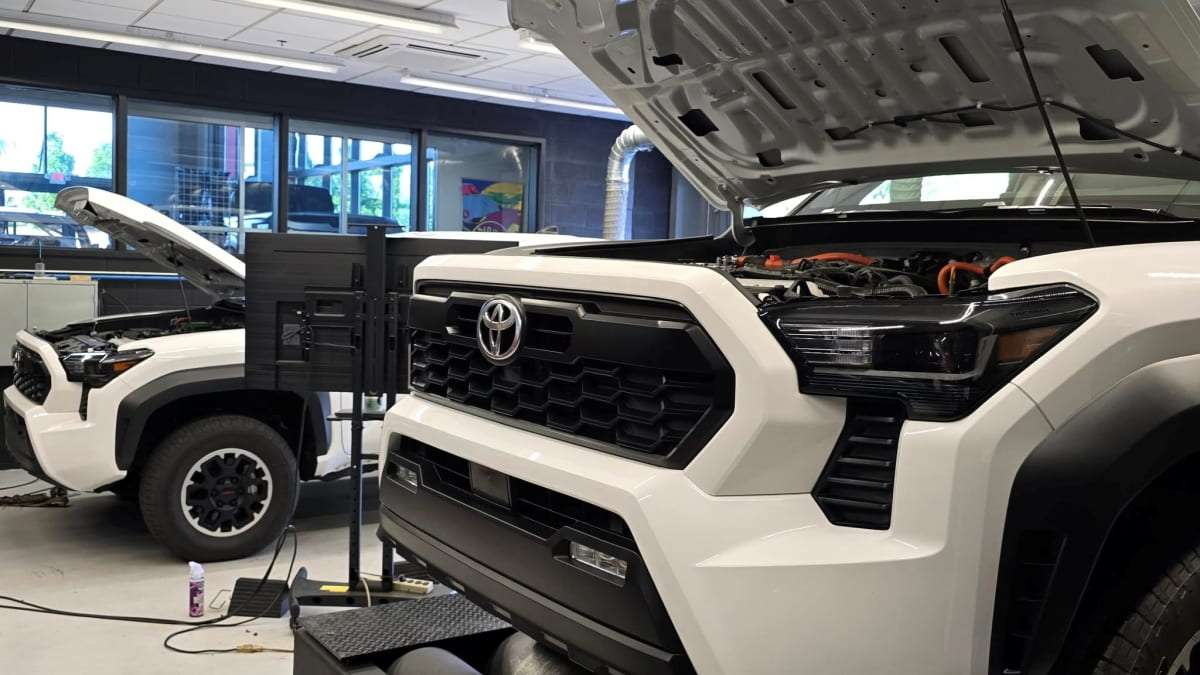
Honest LC250 review that goes into more technical details & why Toyota missed the mark on LC250

There are longfields that have been released for the 250, not cheap but these will likely make the diff or driveshaft the new weak point.

Install instructions make it sound like you are moving parts from old to new which I don;t believe is correct I think these come fully built?


Longfield IFS Axle Set for 2024+ Toyota Land Cruiser LC250
 
I really like Tinkerers stuff, but this review has to be taken in context. It misses the mark for him because he wants to do really technical off-roading and “beef underneath”, and ground clearance are king. What do you suppose is going to happen to all the unwanted 1958’s in the next decade. They are going to be scooped up and HEaVILY modified to be killers at technical rock crawling. Just like every OEM vehicle is HEaVILY modified to be a rock crawler. Meanwhile Broncos will continue to sit on the lot because they are horrendous daily drivers, and LC will continue to sale because they are a great mix and hit the mark for 95% of drivers.
 
Agree with his assessment on most of the points. This struggling 4 cyl does not belong in a 70k truck. Got an Uber ride in a Prius and I was shocked by the similar engine sound / cvt feel of the Landcruiser as it refuses to downshift that give it its buggy feeling. Ofcourse lack of decent tires from factory , smaller axles compared within other Toyota variants, and cheaper CVs are fair points as well.
Got a chance to test drive the gx OT over the weekend and it feels like a completely different truck. The engine sounds amazing, never stops pulling, the ride is compliant and not floaty. The GX is not in the same league of the LC and there should be 15-20k premium delta between the 2
 
Good technical review but it doesn’t take into consideration today’s technical, environmental as well as driving needs for today’s market. The FJ’s are great but for me not an everyday driver the GX 550 doesn’t get the milage and although there is some price overlap it’s still priced considerably higher. The analysis doesn’t hold up as well against the LC or 1958 trims. In my opinion
 
Agree with his assessment on most of the points. This struggling 4 cyl does not belong in a 70k truck. Got an Uber ride in a Prius and I was shocked by the similar engine sound / cvt feel of the Landcruiser as it refuses to downshift that give it its buggy feeling. Ofcourse lack of decent tires from factory , smaller axles compared within other Toyota variants, and cheaper CVs are fair points as well.
Got a chance to test drive the gx OT over the weekend and it feels like a completely different truck. The engine sounds amazing, never stops pulling, the ride is compliant and not floaty. The GX is not in the same league of the LC and there should be 15-20k premium delta between the 2
GX550 "never stops pulling" but is somehow slower than the LC from 30-70MPH ...
 
I have to stop watching YT videos, I love my LC. Can’t wait to do cool mods to it over the next few years.
As for the 4-cyl turbo hybrid, I like it. It runs up the passes just fine for me. I am curious about the comment @ricochet made on his last video comparing the LC to the 4Runner TRD PRO. He mentioned the engines sounded very different among other things.
 
I am beyond sick and tired of videos comparing the 250 to the FJ or 200 series or the 300 series. With click bait claims that they are the “true Land Cruiser” and the 250 is an imposter! Yawn.

I own a GX460 (rebadged 150 series). It’s an amazing vehicle I’ve taken it through some very rough stuff from high passes above timberline to deep mud.

Is the 250 better off road? Yes absolutely. And not it’s not blowing CV joints and differentials.

The fair comparison would be a comparison to the prior 150 series to the current 250 series.


If Toyota ever watered down Land Cruiser, it was the 200 series North American spec.
It was a Lexus and from the factory was “not fit for purpose” . If any version of deserved to have someone question whether it was a “real Land Cruiser”. It would be the North American 200 series. Here are just a few of the items that Toyota neglected to make available on the 200 series as sold in North America: Front locking differential, snorkel, steel wheels, roof rack, auxiliary battery support, heavy-duty tow and recovery points, secondary fuel tank, mud flaps, rubber floor mats. They’re probably probably 50 other things standard or easily optioned on 200 series cruisers sold in the rest of the world. Was it a real land cruiser underneath? Yes! However, they definitely short changed the North American market heavily on this specifications that truly matter off-road.

.
 
Last edited:
Have you driven the gx ?
I have. GX has great acceleration passing power once turbos spool it also burns a lot of gas. LC has better and easier to modulate low rpm torque like a diesel and substantially better fuel economy. LC has the far better powertrain to do LC things. Putting the 5.7 V-8 in 200 series was also not a good powertrain choice.

If you want acceleration go buy a Cayenne or X5 not a LC.
 
I have. GX has great acceleration passing power once turbos spool it also burns a lot of gas. LC has better and easier to modulate low rpm torque like a diesel and substantially better fuel economy. LC has the far better powertrain to do LC things. Putting the 5.7 V-8 in 200 series was also not a good powertrain choice.

If you want acceleration go buy a Cayenne or X5 not a LC.
both trucks returned same mpg results on 75mph car and driver test .
 
LC has the far better powertrain to do LC things. Putting the 5.7 V-8 in 200 series was also not a good powertrain choice.

If you want acceleration go buy a Cayenne or X5 not a LC.
"LC things" are durability, longevity and reliability. A naturally aspirated V8 does that well. There are several million mile 5.7's running around with original drivetrains. Why would it not be a good powertrain choice?
 
"LC things" are durability, longevity and reliability. A naturally aspirated V8 does that well. There are several million mile 5.7's running around with original drivetrains. Why would it not be a good powertrain choice?
The 3UR-FE is a fine choice, just inferior to the T24A‑FTS in some regards. “LC things” mean different things to different people.
 
Dont let nostalgia fool you, this power curve for the I-Force Max 2.4 (Standard and hybrid) is why we no longer use large displacement engines. It is far superior in power, torque, weight, fuel efficiency, and stressload to traditional V-8s which look like a standard bell curve skewed to the right.

Notice on the hybrid how the torque is front loaded and peaks at 1800 rpms which gives it immediate power delivery and takes the burden off the 4 cylinder engine. Thus, in time, we can expect the powerplant to actually last longer than big block alternatives that always have to work a lot harder.

In the past, the industry reluctantly used hybrids to meet fuel economy and emissions standards. Toyota has figured out the combination of a low revving engine plus an electric motor booster is simply a better way to go all around. In our case, about 136 HP per litre (326/2.4) vs about 67 HP for the Tundra V8 (381 HP/5.7 L).


1752858350805.jpeg

 
Dont let nostalgia fool you, this power curve for the I-Force Max 2.4 (Standard and hybrid) is why we no longer use large displacement engines. It is far superior in power, torque, weight, fuel efficiency, and stressload to traditional V-8s which look like a standard bell curve skewed to the right.

Notice on the hybrid how the torque is front loaded and peaks at 1800 rpms which gives it immediate power delivery and takes the burden off the 4 cylinder engine. Thus, in time, we can expect the powerplant to actually last longer than big block alternatives that always have to work a lot harder.

In the past, the industry reluctantly used hybrids to meet fuel economy and emissions standards. Toyota has figured out the combination of a low revving engine plus an electric motor booster is simply a better way to go all around. In our case, about 136 HP per litre (326/2.4) vs about 67 HP for the Tundra V8 (381 HP/5.7 L).


View attachment 42751
this truck does not move nowhere near close to what those numbers suggests . When I first heard this engine has 330 and almost 500lb of torque I thought it would be very quick but then the 0-60 numbers tell another story. Someone needs to explain why Bronco v6, despite being on 35 inch tires and being down 60 tq and same hp values is 1.5 second quicker than the lc . If anything all the low end instantaneous torque should help the lc move quicker off the line but this isn’t the case and inline with 4 cyl badlands with 300hp and 300 tq .

 
Dont let nostalgia fool you, this power curve for the I-Force Max 2.4 (Standard and hybrid) is why we no longer use large displacement engines. It is far superior in power, torque, weight, fuel efficiency, and stressload to traditional V-8s which look like a standard bell curve skewed to the right.

Notice on the hybrid how the torque is front loaded and peaks at 1800 rpms which gives it immediate power delivery and takes the burden off the 4 cylinder engine. Thus, in time, we can expect the powerplant to actually last longer than big block alternatives that always have to work a lot harder.

In the past, the industry reluctantly used hybrids to meet fuel economy and emissions standards. Toyota has figured out the combination of a low revving engine plus an electric motor booster is simply a better way to go all around. In our case, about 136 HP per litre (326/2.4) vs about 67 HP for the Tundra V8 (381 HP/5.7 L).


View attachment 42751
If these numbers aren’t fooling us then someone needs to explain how the Lexus gx with very much identical hp tq figures obliterates the lc in 0-60 and quarter mile . 1.5 seconds quicker and 10mph faster quarter miles are results of 150hp tq difference not 10
 
If someone believes 2+2=7. It’s easier to just say sure, we’ll agree to disagree and move on.
 
Pretty sure the reason the LC doesn’t match 0-60 times is the transition from dead stop until I’d guess late 2nd or 3rd gear, the electric motor doesn’t provide any assist. At least I’ve been unable to get it to engage if the “electric/boost guage” dashboard is to believed. Admittedly I don’t fully believe it, but it’s fairly clear from a butt feel perspective when the electric assist is active or not.

I’m suspicious the electric motor either lacks the controls tuning or physical ability to assist, and as a result is actively inhibited from assisting to prevent damage to the engine. This would be because failure of the electric motor to sync to the engine results in either damage (motor over revvs the engine) or drags the engine from revving (motor is slower than engine).

To clarify, the electric motor as a unit may be physically capable of matching the engine rpm but the controls software or comm bus design or both may lack the latency requirements under conditions where the engine is changing rpm as fast as possible. E.g. CAN bus latency + hardware driver + real time operating stack can respond on order of 100s of ms but not 10s of milliseconds.
 
Supporting Vendors View all →
Back
Top Bottom