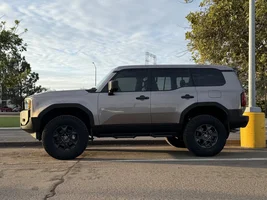
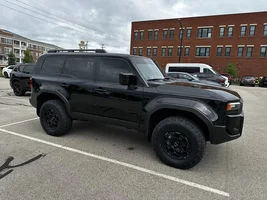
Land Cruiser MY26 changes

I'm actually very curious when Toyota starts bringing the parallel hybrid setup to performance applications. If that pancake motor can add so much to a Land Cruiser, an IS for example would just LAUNCH
I don’t know how well suited it is to track performance. It adds a bit of weight and doesn’t improve 0-60 time over the non-hybrid. It really shines in low-RPM applications, like taking off with a trailer or climbing over rocks.

1756952254462.png
 
I'm actually very curious when Toyota starts bringing the parallel hybrid setup to performance applications. If that pancake motor can add so much to a Land Cruiser, an IS for example would just LAUNCH
You’re thinking of Chinese extended range plug ins like the BYD Fangchengbao Leopard 5 body on frame SUV that have 755hp and about the same number in miles of range? I think there are others that have 900+hp. Toyota should have an answer to those eventually.
 
I don’t know how well suited it is to track performance. It adds a bit of weight and doesn’t improve 0-60 time over the non-hybrid. It really shines in low-RPM applications, like taking off with a trailer or climbing over rocks.

View attachment 46794
If that's the case, gear it higher. The electric motor's high torque will come into play.
 
24.6 gallons on the old LC which got like 15mpg highway.......at 75-80. What an owner told me years back. (rated 13/18) So 24.6x15=369 miles.......what's the big deal? LC250 is 23mpg (22/25) so 17.9 x 23=412 miles. Keeping it real by using the combined numbers
18x24=432
25x17.9 =447
This argument doesn't hold water unless the old one was even worse ........

We’re just expressing our frustration. Very likely nothing Toyota could do to get around the US regulations that pushed them into the micro tank. Hopefully soon retrofit options will be available to restore the fuel capacity to what is normal for the rest of the world.
 
Last edited:
We’re just expressing our frustration. Very likely nothing to really get of time to get around the US regulations that pushed them into the micro tank. Hopefully soon retrofit options will be available to restore the fuel capacity to what is normal for the rest of the world.
Better mileage means you don't need to lug all those extra gallons around though. The numbers above back it up.
 
I don't have complaints about the drivetrain and performance of the current engine, just comparing it to my old Audi A6 C7 TDI. Lots of torque and I gassed up every two weeks. 35+ mpg on the highway and almost 685 miles from a tank and I never babied that car either. I just think this with a diesel, larger tank, and getting something like 550 miles from a tank would be the perfect combo.
Bet that was a dream offroad..............compromise and don't forget dieselgate.....................
 
24.6 gallons on the old LC which got like 15mpg highway.......at 75-80. What an owner told me years back. (rated 13/18) So 24.6x15=369 miles.......what's the big deal? LC250 is 23mpg (22/25) so 17.9 x 23=412 miles. Keeping it real by using the combined numbers
18x24=432
25x17.9 =447
This argument doesn't hold water unless the old one was even worse ........
You’re giving the J200 too much credit on economy. In real-world use, owners rarely see the rated 18 mpg—15 mpg is closer to reality at 75–80 mph. With the U.S.-spec’s undersized 24.6-gallon tank, that’s about 369 miles of range, not the 430+ you’re suggesting.


The J250’s EPA rating is 22/25 mpg, but 23 mpg is the realistic upper limit. On its 17.9-gallon U.S. tank, that works out to about 412 miles (17.9 × 23). At best, that’s only 40 miles more than the J200.


Globally, though, the picture is very different. The J200 was often equipped with a dual-tank system of 138 L (36.4 gal). Coupled with the 4.5L V8 diesel returning 9.5–10.3 L/100 km (roughly 18–20 mpg), this setup provided 1,340–1,453 km of range, or about 833–903 miles between fills.

The J250 continues that pattern overseas with a diesel option and a combined 110 L (29 gal) tank. At 7.6 L/100 km (about 31 mpg), the J250 diesel reaches roughly 1,447 km, or about 899 miles on a full tank.


U.S. buyers never liked the small 24.6-gal tank on the J200, and the patten continues on the even smaller 17.9-gal tank on the J250.

Everywhere else in the world, Land Cruisers deliver 800–900+ miles of range. In North America, regulations keep them capped at under 400 miles.

The land cruiser is an expensive vehicle, but that premium goes towards increased capability. We are just frustrated that local regulations have kneecapped an important capability.
 
Last edited:
Read my text please. Numbers I quoted first are based on combined numbers. Then I gave the highway numbers below. You did not read it carefully. We do agree btw. My 373 mile trip can be done non-stop if needed although the low fuel light will be on......if I get only 21mpg. At 22mpg, I am golden. At 23mpg, it will be as efficient as my Quad (which isn't with 580HP).........
 
Last edited:
Everywhere else in the world, Land Cruisers deliver 800–900+ miles of range. In North America, regulations keep them capped at barely 400 miles.

The land cruiser is an expensive vehicle, but that premium goes towards increased capability. We are just frustrated that local regulations have kneecapped an important capability.
Many other manufacturers besides Toyota offered 50 state US legal diesel 4x4 SUVs with 500+ mile cruising range over the last 10-15 years, but there were never enough buyers to keep the market alive. Even in 2025, diesels are still legal in the USA, and GM dealers should be happy to sell you a new 2025 4x4 Tahoe/Yukon or Suburban with the 3.0 Duramax diesel engine.
Instead, US buyers prefer EV, hybrid, and also plug in SUVs for extended range. Agree that in 5 years the LC250's current cruising range and power output will seem very low compared to the extended range/plug in EVs such as Scout.
 
Last edited:
Read my text please. Numbers I quoted first are based on combined numbers. Then I gave the highway numbers below. You did not read it carefully. We do agree btw. My 373 mile trip can be done non-stop if needed although the low fuel light will be on......if I get only 21mpg. At 22mpg, I am golden. At 23mpg, it will be as efficient as my Quad (which isn't with 580HP).........
Agreed sorry about that. You are braver than I. I ran mine out of gas at exactly 360miles from last fill up. The hybrid limp mode did get me to the next exit. I'm running 275 AT tires though
 
Many other manufacturers besides Toyota offered 50 state US legal diesel 4x4 SUVs with 500+ mile cruising range over the last 10-15 years, but there were never enough buyers to keep the market alive. Even in 2025, diesels are still legal in the USA, and GM dealers should be happy to sell you a new 2025 4x4 Tahoe/Yukon or Suburban with the 3.0 Duramax diesel engine.
Instead, US buyers prefer EV, hybrid, and also plug in SUVs for extended range. Agree that in 5 years the LC250's current cruising range and power output will seem very low compared to the extended range/plug in EVs such as Scout.
I wouldn’t say “many.” GM does offer the Tahoe, Suburban, and Yukon with the 3.0 Duramax, but that’s literally the only new diesel SUV left in the U.S.—and they’ll almost certainly be the last.

Diesels have been all but eliminated from anything outside of trucks in the U.S., largely due to deliberate regulatory policy decisions. California has already set a path to eliminate them entirely within the next decade. Compliance costs climb every year—EPA and CARB standards mean costly after-treatment systems, additional certification expenses, and ongoing emissions service. That wipes out the business case for a relatively low-volume vehicle like the Land Cruiser. GM can just barely spread those costs across mass-market SUVs that sell almost exclusively in North America, but Toyota can’t justify it on a global product where most sales are outside the U.S. Even so, I’d be surprised if diesel accounts for even 25% of Tahoe, Suburban, or Yukon sales. Don't be surprised to when GM drops that option just like everyone else.


On top of that, federal and state tax policies mandate that diesel fuel be more expensive here than gasoline. The federal excise tax 34% higher on diesel. Then you have state taxes and diesel surcharges. California, for example, layers on both excise and sales tax that are nearly 4X the taxes on gasoline. By contrast, Europe, Australia, and other markets structure tax policy to favor diesel, often making it cheaper at the pump than gas.

That’s why Toyota positioned the 2.4L hybrid as the closest substitute for diesel-like torque and efficiency in North America. It’s not the same as the global 2.8L diesel with 800–900 miles of range, but it reflects U.S. realities: stricter environmental regulations, higher compliance costs, lower diesel volumes, and fuel pricing that punishes diesel ownership.

And I agree with your point about long-range EVs—five years from now, the J250’s ~400-mile cruising range will look limited next to extended-range plug-ins like Scout. Policy decisions are forcing the market in that direction. The trade-off is that these vehicles will be far more complex and expensive than the simpler and more reliable long-range diesel Land Cruisers the rest of the world still gets.
 
A prime reason diesels are disappearing relates DIRECTLY to the aftermarket 10-15 years ago. My speed shop was tuning 1000+++ft-lb monsters (for tractor pulls yea right) that could smoke out a neighborhood when doing a dyno pull. The fines for that stuff have become HUGE!!! To make it clean , DEF and all the other stuff are involved. Diesels mileage drops a lot in the winter with the winter fuel mix (precisely when I started my winter driving season I found out).
So the claimed 26mpg highway numbers on my X5d were really ~23mpg and the diesel was $1/gal greater than premium a few years. Also DEF tank failures were pretty much guaranteed , yet unwarrantied or recalled.....In typical BMW fashion, they did not correct the problem from the E70 vintage but carried it over unchanged into the F vintage. When the BMW service manager closes the door and suggests you don't want to go thru the same issues again (do buy another), you listen!!!
Hybrid tech has out efficiencied Diesel......465ft-ls Tq used to be a diesel number. Times and tech change.
I doubt you could sell 1000 Diesel Land Cruisers/yr. Read latest Hagerty if you want a good joke about the prior Land Cruiser BTW. Something like sold by the dozens..........
 
A prime reason diesels are disappearing relates DIRECTLY to the aftermarket 10-15 years ago. My speed shop was tuning 1000+++ft-lb monsters (for tractor pulls yea right) that could smoke out a neighborhood when doing a dyno pull. The fines for that stuff have become HUGE!!! To make it clean , DEF and all the other stuff are involved. Diesels mileage drops a lot in the winter with the winter fuel mix (precisely when I started my winter driving season I found out).
So the claimed 26mpg highway numbers on my X5d were really ~23mpg and the diesel was $1/gal greater than premium a few years. Also DEF tank failures were pretty much guaranteed , yet unwarrantied or recalled.....In typical BMW fashion, they did not correct the problem from the E70 vintage but carried it over unchanged into the F vintage. When the BMW service manager closes the door and suggests you don't want to go thru the same issues again (do buy another), you listen!!!
Hybrid tech has out efficiencied Diesel......465ft-ls Tq used to be a diesel number. Times and tech change.
I doubt you could sell 1000 Diesel Land Cruisers/yr. Read latest Hagerty if you want a good joke about the prior Land Cruiser BTW. Something like sold by the dozens..........
Excellent points all around.

Are you referring to the clickbait Hagerty video, “How Toyota Got the 2024 Land Cruiser So Wrong” by Jason Cammisa?

That review was deeply misguided—he even claimed the GX was the “true” Land Cruiser while dismissing the Land Cruiser itself.

The reality is that the U.S. spec J200 Land Cruiser had become an aberration, sold as an ultra-luxury V8 SUV while the global tradition centered on durable 4- and 6-cylinder workhorses built for reliability and off-road toughness. His framing of the 2024 J250 as a misstep for reduced pricing, lacking a V8 and high end luxury features misses the point of a Landcruiser entirely. Jason really comes across as a complete fool.

In fact, the J250 realigns the U.S. offering with the global standards, and sales have already proven the wisdom of Toyota’s approach—U.S. demand has quadrupled compared with prior years. Toyota clearly knows what it’s doing and in this case at least, Jason Cammisa does not. He usually brings solid insight, but here he spoke on a topic he clearly didn’t understand.

Hopefully his next video is not titled: "How Alfa Romeo Got the Giulia So Wrong" and then wax eloquently for 20 minutes that prior Alfas Were Slow, Boring, and Reliable...
 
Last edited:
No, Jason is an ass.
My issue #93 of Hagerty club. Hope it is readable.
 

Attachments

  • 20250904_200457.webp
    20250904_200457.webp
    379.9 KB · Views: 173
I will personally kick him in the nuts if he disses Alfa. Nothing short of the most fun, most involving, tactile vehicles out thee...and of course Lotus. They have completely stolen the word ultimate from beemer. My Stelvio Quad at 580hp is a sick puppy!!!
 
Afraid you've got that backwards.

Toyota offered the J200 with a factory-fitted sub tank. 93 L (main) + 45 L (sub‑tank), delivering a total of 138 L, which equates to approximately 36.4 U.S. gallons. This configuration was offered as standard in many regions globally.

When paired with the 4.5L twin-turbo diesel V8, which typically returns about 18–20 mpg, this setup provided an effective range of roughly 650–725 miles.

Bottom line the J200 is capable of exceptional range by any standard.

Unfortunately over half that capability was lost when it was forced to to comply with local regulations in the United States.

It wasn’t Toyota’s preference to install a smaller tank or a thirsty gas engine the U.S. regulatory environment forced that on them.
Not doubting you - this sounds logical. But how does the regulatory environment figure into fuel tank size? Honest question.
 
Not doubting you - this sounds logical. But how does the regulatory environment figure into fuel tank size? Honest question.
I'm not an automotive engineer, but neither are the folks that dream up these regulations. Many folks only think about regulations only in terms of MPG ratings and tailpipe emissions, but the regulators did not stop there. It’s far more complicated.

FUEL TANK
Compliance applies to the entire fuel system—tank design, vapor control, refueling systems, and safety integrity. Toyota had to comply with EPA evaporative emissions standards (40 CFR Part 86, Subpart B), Onboard Refueling Vapor Recovery (ORVR) requirements, and , plus even stricter CARB evaporative standards. Larger or dual tanks generally increase vapor permeation surface area, change how ORVR refueling hardware works. Meeting those requirements for a relatively low-volume model like the Land Cruiser probably didn’t make sense for Toyota. Maybe designing a larger volume tank to meet those requirements would have reduced ground clearance or literally not physically be possible.

CRASH TESTING
Under FMVSS 301 (Fuel System Integrity), the U.S. rules are very strict about fuel leakage after a crash:
During the impact: fuel spillage can’t exceed 1 ounce per minute. After the impact: total spillage can’t exceed 142 grams (about 5 ounces) over the next 5 minutes, and then it must drop to no more than 1 ounce per minute for the following 25 minutes. In addition, the fuel tank, lines, and fittings must remain attached and the system has to show no continuous leaking. That’s why auxiliary tanks can problem every seam, hose, and valve is another chance to fail these limits. Basically you are doubling your potential failure points going into the most expensive and complicated crash test regimens in the world.

MPG
Most people assume the EPA’s MPG numbers come from real world driving a car and measuring fuel burned. In reality, it’s far more convoluted and grossly misinform buyers. EPA fuel economy testing is done on a chassis dynamometer in a lab, where the vehicle “drives” through scripted cycles that claim to simulate city and highway conditions. Vehicles aren’t tested at their exact curb weight—instead, they’re assigned to a test weight class, which includes curb weight plus a 300-lb allowance. The problem is that those classes are stepped in 125 pound increments. Add enough weight—say 75 pounds of extra fuel from a larger tank—and you can push a vehicle into the next higher test weight class adding. That bump matters because the dyno is then set with higher inertia and rolling resistance to simulate the vehicle actually being heavier than it actually is! One other wrinkle is that the EPA “highway” test cycle doesn’t actually look anything like real real world highway driving. People assume it’s a steady 70mph mph cruise, but it’s not. The EPA’s Highway Fuel Economy Test (HWFET) runs on a dyno over a scripted cycle that lasts about 12.5 minutes and covers 10.26 miles. Average speed is only 48 mph, the top speed is only 60 mph. There are multiple periods of braking, stopping, coasting, and acceleration. Does that sound like highway driving to you? Too bad, EPA don't care! Even though 75 pounds doesn’t sound like much and its not in the real world, in EPA math world where weight class and inertia is so important it can drag efficiency numbers down enough to hurt the official MPG label. And since every Land Cruiser sold in the U.S. counts against Toyota’s CAFE compliance, even a 1 mpg hit carries corporate fleet wide cost implications.


The small tank wasn’t Toyota’s preference—it was a direct result of regulation-driven design constraints unique to the U.S. market.
 
I will personally kick him in the nuts if he disses Alfa. Nothing short of the most fun, most involving, tactile vehicles out thee...and of course Lotus. They have completely stolen the word ultimate from beemer. My Stelvio Quad at 580hp is a sick puppy!!!
I had a friend with a 164QV with the manual I got to drive in the late 90's. It was epically good. My wife rented a Giulia Quad recently. Wow! Completely agree on BMW. They have truly lost their way. So sad what they have become.
 
Supporting Vendors View all →
Air Down Gear
Back
Top Bottom