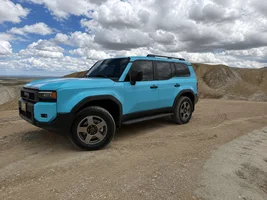
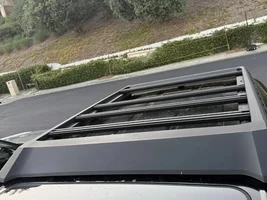
Great job Toyota . The new Kia telluride comes with higher ground clearance and better offroad tires, and the rear seats fold completely flat

Oh wow. You’re right, my mistake. Clearly Toyota and the rest of the world have had it wrong. Decades of diesels the world over, from the Outback to the Kalahari and from NGOs to militaries, all got it backwards. The better answer clearly was a supercharged gas V8 and now a high-output twin-turbo running premium.


Range, heat management, sustained load and fuel logistics all must come secondary to horsepower in a utility vehicle.


The hybrid four isn’t Toyota trying to preserve Land Cruiser fundamentals under Byzantine regulations. It’s just more of Toyota once again getting it wrong.

Thanks for clearing that up for the rest of us.
You have reading comprehension issues. Your posts are not even funny. Apparently, you just have a huge hard on for diesels in some unfulfilled fantasy land in your head. Where are YOU driving to... that a 3UR can't go? I've also been driving Diesel Land Cruisers for decades now. I don't think there's much more you could tell me about them. Save your breath.
 
You have reading comprehension issues. Your posts are not even funny. Apparently, you just have a huge hard on for diesels in some unfulfilled fantasy land in your head. Where are YOU driving to... that a 3UR can't go? I've also been driving Diesel Land Cruisers for decades now. I don't think there's much more you could tell me about them. Save your breath.
If you have driven diesel Land Cruisers for decades, then you already understand the point you are arguing so hard against. That is what makes this exchange a little strange. This was never about where a 3UR physically can or cannot go. Of course a 3UR can get most places. That is a straw man you keep building.

The discussion has been about fit for purpose, not fantasy destinations. Toyota built diesels for the Land Cruiser everywhere it actually gets used as a work vehicle where durability and capability are paramount. That does not mean the 3UR is bad. It means it solves a different problem for a different buyer less concerned about those priorities.

If you want to reduce that to “having a hard on for diesels,” that is fine. But dismissing the global design logic Toyota followed for decades does not make your argument stronger, it just avoids engaging with it. You clearly know better, which makes the response more about ego than substance.

If you are done discussing it, that is your call. The facts do not change either way.
 
Basically, you are saying the 200 was trash because it didn't come to the US with a diesel engine. You could've saved a lot of AI bandwidth by just stating that. Did you know there were zero Land Cruisers sold in the US with a diesel engine? So they must all be trash, right?

There's a home in CA called the Winchester Mystery House (related to your screen name). It has doors and staircases that go around and around and lead up to nothing. You would like it, it's just like your posts.
 
Again nobody is suggesting anyone should do trade in an lc for a Kia . My point is that even when Kia attempts to create something that remotely resembles an off-roader they understand the importance of ground clearance, flat folding rear seats and good tires but apparently both of these factors were overlooked by Toyota on a dual lock dual speed transfer case truck
Boring, I wouldn’t drive any Kia down my 250 foot gravel driveway… That’s serious off-roading for a Kia.
 
Basically, you are saying the 200 was trash because it didn't come to the US with a diesel engine. You could've saved a lot of AI bandwidth by just stating that. Did you know there were zero Land Cruisers sold in the US with a diesel engine? So they must all be trash, right?

There's a home in CA called the Winchester Mystery House (related to your screen name). It has doors and staircases that go around and around and lead up to nothing. You would like it, it's just like your posts.
No, I’m not saying the US 200 was “trash,” and pretending I am is just another dodge. What I said, very clearly, is that the US 200 was neutered relative to what the rest of the world got, and that decision was a mistake. The sales numbers back that up. Toyota took a globally work-oriented platform and repositioned it here as a luxury flagship that overlapped almost entirely with Lexus. Buyers noticed, and it sold poorly.


Yes, the US never got a diesel. That is the point, not a rebuttal. Everywhere else, Toyota prioritized range, torque, heat management and sustained-duty capability. In the US, Toyota prioritized comfort, peak power and price. That does not make the 3UR a bad engine, but it does make the US configuration a poor fit for what a Land Cruiser historically represents.


The repeated personal attacks and side comments are telling. Each time the argument shifts from substance to ad hominem, it is because there is nothing left to rebut on the merits. Calling the US 200 “neutered” was about mission, not ego. The US version lost the attributes that defined the Land Cruiser globally and gained the attributes of a Lexus.


You can keep reframing that as “you think all US Land Cruisers are trash” or keep taking shots at me personally if you want, but it does not change the reality. Toyota themselves corrected course. The US 200 didn’t fail because Americans don’t like Land Cruisers. It failed because Toyota stopped selling one here in any meaningful global sense of the term.

Let’s keep the discussion focused on the substance and avoid personal remarks. The repeated use of crude language doesn’t add anything to the argument and is likely to cause problems for you, not advance the discussion.
It doesn’t seem like you’re really responding to any specific points, you’re just filling the airwaves with AI paragraphs.
 
It doesn’t seem like you’re really responding to any specific points, you’re just filling the airwaves with AI paragraphs.
Let me be very clear, because this keeps getting mischaracterized. The 200 platform itself was not junk and it was not a philosophical break. Globally, the 200 remained very much a Land Cruiser in purpose and execution. The US-spec version is where the break occurred. And I’m not hand-waving or filling space, I’m responding to a specific technical point about those arguing the US Version of the 200 was not compromised or was the "flagship version".

If you look at the Land Cruiser lineage before the 80 Series, the pattern is consistent. The 40 and 55 Series commonly ran 3.9–4.2L inline-6 engines (such as the F and later 2F), while earlier variants also used inline-4s. The 60 Series continued with the 4.0L inline-6 (2F) and later the 4.0L inline-6 (3F). These were not big engines chasing power. They were long-stroke, low-RPM torque motors designed for durability, load carrying, and sustained operation.The 80 Series continued that philosophy with the 4.5L inline-6 (1FZ-FE).

The 100 Series is where the drift began. The 4.7L V8 (2UZ-FE) was still conservative and reliable, but it marked the first move toward more cylinders, more refinement, and more luxury influence in the US market, while still remaining globally aligned. The 200 Series globally doubled down on the Land Cruiser mission with the 4.5L V8 diesel (1VD), optimized for torque density, efficiency, range, and sustained load. That is not a philosophical break.

The US 200, however, was sold with a single option, the 5.7L V8 (3UR-FE), which was a large displacement increase and pushed the platform toward peak power, higher fuel consumption, and luxury-market expectations. That shift in the US is what broke alignment, not the 200 platform itself. Again I'm not saying the 3UR is a bad motor, I owned a Tundra. It definitely has its place, but was it fit for purpose in a Land Cruiser being used in its element? No it was not.

This is also where some claims about the GX550 being the “superior” Land Cruiser engine come from. There is a misunderstanding that a Land Cruiser engineer should be based on high HP miss the point of a Land Cruiser entirely. That may be desirable in a premium luxury SUV, but it departs from Land Cruiser design priorities.

This difference is often misread as “Americans don’t want diesels,” but that’s not accurate. Diesels struggled here because of emissions and regulatory costs, not lack of consumer interest. EPA, CARB, and CAFE requirements made certifying light duty truck diesels from foreign manufactures extremely difficult. In markets without those constraints, diesels remained dominant because they best fit the Land Cruiser use case. That context matters. Toyota didn’t abandon diesels globally. They were effectively regulated out of the US market. So the absence of a diesel in the US 200 wasn’t a rejection of the Land Cruiser concept, it was a regulatory reality that pushed Toyota toward a luxury-oriented large displacement gas configuration here.

That’s why the 2.4L hybrid four in the 250 is a pragmatic return to Land Cruiser fundamentals while still meeting US diesel regulations. Fewer cylinders, smaller displacement, strong low-RPM torque, and better efficiency under load. It's the best they could do since they could not bring the diesel to the states. It aligns far more closely with how Land Cruisers have been powered globally far decades. Certainly a heck of a lot more than a large gas V8, supercharged V8, or high-output twin-turbo V6.
Mate I’m not reading that AI wall of text, but if you want to have an actual human conversation I’d be into it. (See: the specific question I asked you previously.)

 
Back before the LC 250 was available, we almost went with the Telluride - Nice looking, great interior, 3rd row, but something was amiss and after the new LC was announced we were sold on it and waited a year before getting one - Have not been disappointed. Got the 2024 FE in July '24 and SO HAPPY we waited - Looking forward to all the years and adventures we are going to have, and our kids are already jockeying for who will get it once they put me in the old folk's home.
 
In that last sentence, what are the things you’re referring to when you say it is “terrible for everything the platform was designed for.”?
To clarify, I didn’t say it was “terrible for everything the platform was designed for.” What I said was that it runs counter to many of the core design priorities of the Land Cruiser platform.


When I refer to the platform’s design intent, I’m talking about durability, long-range capability, thermal stability, serviceability, and reliability under sustained load in remote or harsh environments. Historically, the Land Cruiser has prioritized low-stress operation, large reliability margins, and simplicity over peak output.

The supercharged 3UR emphasizes maximum power, which inherently brings higher thermal and mechanical loads, added complexity, increased fuel consumption, and a greater sensitivity to fuel quality. None of that makes it a bad engine, and for certain use cases it may be perfectly appropriate. It just represents a different set of priorities than those the Land Cruiser was originally engineered around.
 
Last edited:
1765858444491.webp

At this point this is just sad.
 
At this point this is just sad.
Yes it really is. Arguing that Toyota should switch to a supercharged 3UR is sad. AI is helpful explaining that to some people who don’t self evidently understand why that would be a poor design choice.
 
To clarify, I didn’t say it was “terrible for everything the platform was designed for.” What I said was that it runs counter to many of the core design priorities of the Land Cruiser platform.
Actually, you did say that - I directly quoted you. You realize we can just scroll up and see what you wrote right?

When I refer to the platform’s design intent, I’m talking about durability, long-range capability, thermal stability, serviceability, and reliability under sustained load in remote or harsh environments. Historically, the Land Cruiser has prioritized low-stress operation, large reliability margins, and simplicity over peak output.
Ok, fine. So which of these is the 3UR not meeting:? Durability? Long-range capability? Thermal stability? Serviceability? Reliability?

The supercharged 3UR emphasizes maximum power, which inherently brings higher thermal and mechanical loads, added complexity, increased fuel consumption, and a greater sensitivity to fuel quality. None of that makes it a bad engine, and for certain use cases it may be perfectly appropriate. It just represents a different set of priorities than those the Land Cruiser was originally engineered around.
You should read about MECE principles. You could have ChatGPT craft a crash course on it for you.
 
Yes it really is. Arguing that Toyota should switch to a supercharged 3UR is sad. AI is helpful explaining that to some people who don’t self evidently understand why that would be a poor design choice.
This is really cringey man.
 
Actually, you did say that - I directly quoted you. You realize we can just scroll up and see what you wrote right?


Ok, fine. So which of these is the 3UR not meeting:? Durability? Long-range capability? Thermal stability? Serviceability? Reliability?

I stand corrected, I did say a Supercharged 3UR was a terrible choice for everything the platform was designed for. My Apologies.

The 3UR is a great motor and I’ve owned one. It’s very reliable compared and long lasting to a GM Ecotec of Ford Coyote. However everything is relative. The 3UR not in the same mythical durability class as the 2UZ or the many of the Land Cruiser diesels that regularly rack up 400k to 500k miles. It’s all relative. Some of Toyota’s engines have a history of going huge mileage and those are the ones that generally ended up in Land Cruisers. The 3UR is very good by modern standards, just not quite in that truly legendary longevity category. A supercharger won't improve that aspect.
 
My Apologies. It was not directed at you, but I can see how it came across that way. I am sorry.
No worries my friend. I don’t assume malice.

I try to remind myself I don’t need to build myself up by tearing others down. Similarly, we don’t need to tear down a legendary power train (URJ) in order to validate our decisions to seek something different.

I wish you well and look forward to many more passionate discussions with you.
 
This is like reading through a transcript from a Jubilee debate...which is like banging your head on concrete wall... over and over...
 
Eleven pages of exactly what is a bit puzzling. Anyone had the sense to go back to the beginning of this thread and ponder how it evolved ? I'm afraid to go outdoors without a gun after reading through this mess
Some haven't touched grass since the China-virus. 🫨
 
Back
Top Bottom