Correct Pressure for E load

I regret putting E load tires on. But is what is. Going back to SL once these wear out. But running my e loads at 42 vs 35 psi is a huge difference. The car rides a lot better at 35 and I have much better control of the steering wheel.

My suggestion. Drive it in the extremes of where you think it should be. Say you are deciding between 45 and 35. Drive it on one end for a day and switch to the other end for a bit, and choose the pressure that feels best to you.
Your tire guy has probably not driven the LC as a daily. Those tires are usually run by heavier trucks and have different psi range than a lighter LC.
 
I am on 35" E load and searching for my next set. Plan for now is for somewhere in 33"-34" range and SL if I can find them.
 
Everywhere I look, Tire Rack, other tire specialty tire sites etc, confirm the E load tire with a max potential inflation pressure of 80psi, when comparing to an equivalent SL sized tire that is placard recommended at 33 psi, suggest the pressures should be in the 40-50 psi zone. Even recommend the chalk test! Running lower pressures may "deaden" the harshness of the sidewalls, but will do nothing to enhance ride, handling, mileage and any other factors. Sure, low pressures off road are great, but an underinflated E Load tire at 80 mph on the high is just plain underinflated below 40psi IMHO. Underinflated definitely diminishes that already diminished on road capabilities.

I still strongly believe the only LCs that should run E loads are rock crawlers and coarse sharp rock laden back roads. An XL or C load tire with our vehicles would be a better choice for "upgrade". E Load is a great choice for an F250, GMC 2500 that routinely does heavy towing or hauling a ton plus.
There seems to be a big time macho man tire need that 90+% will never remotely use the potential of....blasphemy for some, common sense for the rest of us. The trade offs are obvious.
I was able to ask an Engineer at BF Goodrich about proper inflation of E load tires and he said there is a calculation to determine proper inflation, but that is only half the story.

He said you can run them at the door sticker pressure or pretty much any other pressure and not damage the tires.

When I did the chalk test, I tried four different pressures and I got the same result every time, which he indicated didn't surprise him.

At the end of the day, I switched from the stock tires because one of the stock tires developed a bubble after driving down a fairly smooth dirt road.

I went with the K03s because I do go off-road and they don't make a non-E load right now.

Depending on the need I run my E load tires at 36 psi/45 psi/ 50 psi and even 18 psi (when I am going off road and need better traction).

I have not found the ride punishing at any of those PSIs.
 
Last edited:
An E-load tire at 50 PSI on this suspension would be absolute misery. Thatโ€™s a silly suggestion.
Not every LT tire has a similar tread design or width. . Some are designed for smoother on road comfort at high speeds or pressure, and others have more aggressive tread that will ride rough at high pressures. Narrower "pizza cutters" should usually be able to run smoothly at higher pressures also.
 
An E-load tire at 50 PSI on this suspension would be absolute misery. Thatโ€™s a silly suggestion.
Over inflated is no better than under inflated. I'll stick to the ETRTO load inflation tables which are used as the design spec for tires across all manufacturers. I can certainly attest to a significant difference in harshness when I air down my WildPeak AT4w tires.
 
Silly maybe but that is the reality of the professional recommendeations. Also, if you read closely, I said 40 to 50 psi, not 50psi as an absolute.
Running an E load at recommended pressures may indeed be misery....Might be why Toyota does NOT offer them as a stock option as some complained about earlier. And of course, NOTHING against altered pressures in offroad situations. Basically, I bet its 1% of owners that will actually NEED the capabilities of an E Load tire. Again, put them on for your adventure, take them off when done. Just like a track car.
 
Last edited:
Silly maybe but that is the reality of the professional recommendeations. Also, if you read closely, I said 40 to 50 psi, not 50psi as an absolute.
Running an E load at recommended pressures may indeed be misery....Might be why Toyota does NOT offer them as a stock option as some complained about earlier.
Which โ€œprofessionalsโ€ recommend running e-loads at these pressures on a midsize off-roader? If thatโ€™s not the application they recommend it for, itโ€™s irrelevant to this conversation.

The simple answer to all of this is actually to just ignore blanket recommendations on pressure and just do a chalk test.
 
I stated that above also. Do search and start reading. Indeed it is all over the map............I guess one may say, your needs may vary. Higher prressures are definitely needed for bigger loads. Signing out on this one

From what I have read here, there is a WIDE range of pressures that can get the job done. The sidewalls are so stiff, they are far less dependent on pressure to maintain a contact patch that promotes proper wear. My gut and what I have read suggest that an E load is designed to run at a higher pressure than a C load, Xl load or SL load. Running lower pressures accommodates those negative trade offs to a certain extent and if you came out of a 250 Series pickup, LC will feel like a Cadillac anyway. Only real way to determine properpressures would be a long drive followed by immediate pyrometer evaluation. I have seen truck tires bald in the middle and on the other end, edges completely worn out (not toe related feathered wear).....It appears some get it right, others do notBe nice to review this after another year and 20-30K miles......

chalk testwas state of the art in the 1960s and before.........pyrometer is the proper way now
 
Last edited:
I stated that above also. Do search and start reading. Indeed it is all over the map............I guess one may say, your needs may vary. Higher prressures are definitely needed for bigger loads. Signing out on this one
No, no research needed - just looking for anything to support your assertion. Iโ€™m able to set appropriate tire pressure without any professional input ๐Ÿ˜Š
 
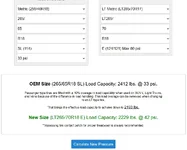
Just found this site. According to what I entered we should be running 42 psi. I'm going to increase to 38-40 and see how they feel.
Same here.
Use this site very often... Got same results...

I changed stock to BFG KO3 LT265/70 R18 124/121S E

42psi instead of 33 for the stock tyres...

So now I am wondering, gravel, mud, sand, instead of 25psi, 20psi, 10 psi, should I run 35psi, 30psi, 20psi?

By the way, US$ 100,000 for the TXL in Costa Rica, CoolBox in the center console and cool seats but no TPMS for an offroad vehicle! Toyota, this is CRAZY! :mad:

And as a bonus..., no automatic door close... For that you need the VX model, US$ 120,000! :oops:
 

Attachments

  • Captura de pantalla 2026-01-06 103758.webp
    Captura de pantalla 2026-01-06 103758.webp
    49 KB · Views: 139
Last edited:
I changed stock to BFG KO3 LT265/70 R18 124/121S E

42psi instead of 33 for the stock tyres...

So now I am wondering, gravel, mud, sand, instead of 25psi, 20psi, 10 psi, should I run 35psi, 30psi, 20psi?
Probably not. You want flex, and you typically have to air down more with stiffer sidewalls to get the same traction. On my e-load Mickey Thompsons I need to get into single digits before I start really enlarging the contact patch.

Thereโ€™s no set number - youโ€™ll learn with time what pressures work with your specific buildout, and it will vary with conditions.
 
Probably not. You want flex, and you typically have to air down more with stiffer sidewalls to get the same traction. On my e-load Mickey Thompsons I need to get into single digits before I start really enlarging the contact patch.

Thereโ€™s no set number - youโ€™ll learn with time what pressures work with your specific buildout, and it will vary with conditions.
Single digit!?
I assume not for gravel.
So rock crawling on 9psi max? :oops:

If I need to deflate/inflate every time from 38-40 to 9psi and back up, on a ARB Single Compressor... then I wish I had bought a Unimog with automatic inflation system! I'm screwed! Well I bought them for resistance/durability, not sure I'll need the added patch for traction... I will not do sand, not much mud, and not extreme rock crawling...

I'll see and report back...
 
Single digit!?
I assume not for gravel.
So rock crawling on 9psi max? :oops:

If I need to deflate/inflate every time from 38-40 to 9psi and back up, on a ARB Single Compressor... then I wish I had bought a Unimog with automatic inflation system! I'm screwed! Well I bought them for resistance/durability, not sure I'll need the added patch for traction... I will not do sand, not much mud, and not extreme rock crawling...

I'll see and report back...
No, not gravel. For gravel just air down a bit for comfort and to preserve the road. Single digits I do for very low traction surfaces like deep mud and snow, or if going over very, very many largish (8+โ€) rocks. I donโ€™t really do much actual rock crawling - Iโ€™m more interested in off-roading as a means to an end.

I hate airing down and back up, so Iโ€™ve spent a lot of time and money making it easier. Apex RPV valves to let the air out on a flash (approximately 2 PSI per second); a Morrflate 4-tire hose system so I can air them all up at once and auto-balance the pressure (can also be used to air them all down at the same time, but thatโ€™s slower than pulling the Apex valves); Morrflate Tensix PSI Pro so I can set the target pressure and then sit in the cab or let my mate Rocky explore nearby while it auto-inflates; and finally I installed an Anderson SB50 port in the cargo area just below the OEM jack compartment so I can just plug in the compressor instead of getting into the 12v battery compartment and trying to get alligator clips on the terminals.

I feel like you may have missed the most significant part of my previous comment:

Thereโ€™s no set number - youโ€™ll learn with time what pressures work with your specific buildout, and it will vary with conditions.

If anyone tells you โ€œuse this specific PSI off-roadingโ€ then theyโ€™re talking nonsense.
 
We did a video on this and some myths about tire ply's etc. We spoke to Todd Bergerson, Sr Manager of Product Planning & Technical Services. Very informative.

 
No, not gravel. For gravel just air down a bit for comfort and to preserve the road. Single digits I do for very low traction surfaces like deep mud and snow, or if going over very, very many largish (8+โ€) rocks. I donโ€™t really do much actual rock crawling - Iโ€™m more interested in off-roading as a means to an end.

I hate airing down and back up, so Iโ€™ve spent a lot of time and money making it easier. Apex RPV valves to let the air out on a flash (approximately 2 PSI per second); a Morrflate 4-tire hose system so I can air them all up at once and auto-balance the pressure (can also be used to air them all down at the same time, but thatโ€™s slower than pulling the Apex valves); Morrflate Tensix PSI Pro so I can set the target pressure and then sit in the cab or let my mate Rocky explore nearby while it auto-inflates; and finally I installed an Anderson SB50 port in the cargo area just below the OEM jack compartment so I can just plug in the compressor instead of getting into the 12v battery compartment and trying to get alligator clips on the terminals.

I feel like you may have missed the most significant part of my previous comment:


If anyone tells you โ€œuse this specific PSI off-roadingโ€ then theyโ€™re talking nonsense.
No, I did not miss that.
I know every road is different, every car has different weight, each car has probably different tyresโ€ฆ

I will get information on my car/tyres/surfaces along the way, but I need to start somewhere, when deflatingโ€ฆ I was just appaled that you said single digitโ€ฆ I would never deflate to single digit on fast gravel road as a starting pointโ€ฆ
So thatโ€™s why I assumed there had been some miscommunication, thus I wanted to point that outโ€ฆ
 
No, I did not miss that.
I know every road is different, every car has different weight, each car has probably different tyresโ€ฆ

I will get information on my car/tyres/surfaces along the way, but I need to start somewhere, when deflatingโ€ฆ I was just appaled that you said single digitโ€ฆ I would never deflate to single digit on fast gravel road as a starting pointโ€ฆ
So thatโ€™s why I assumed there had been some miscommunication, thus I wanted to point that outโ€ฆ
Cool sounds good
 
Have we figured out the right pressure? I am running 32 on mine and its still al ittle harsh, but ok. Chalk test just came out even on everything so has been hard to determine what is right.

Did anyone land on what PSI on rocky, washboards, Sand... and at what PSI on an E load is there a risk of losing the bead offroad? Im not used to single digit PSI at all.
 
Have we figured out the right pressure? I am running 32 on mine and its still al ittle harsh, but ok. Chalk test just came out even on everything so has been hard to determine what is right.

Did anyone land on what PSI on rocky, washboards, Sand... and at what PSI on an E load is there a risk of losing the bead offroad? Im not used to single digit PSI at all.
A while ago, I reached out to a BF Goodrich Engineer (LinkedIn searching) and he was kind of enough to respond to my email.

He said that anything from the door sticker for stock tires pressures (if keeping the same size tires) to up to 50psi would be fine.

Essentially, he said that the sidewall is so thick with an "E" load tire that there really isn't a pressure which is going to damage the tire, adding that he was not surprised that the chalk test came out the same for various pressures.

With regards to lowering the pressure for off-road, I asked him and he suggested anywhere from 17-20psi. He said that one should have a bead locker if one is going to single digit PSIs.
 
Last edited:
A while ago, I reached out to a BF Goodrich Engineer (LinkedIn searching) and he was kind of enough to respond to my email.

He said that essentially anything from the door sticker for stock tires pressures (if keeping the same size tires) to up to 50psi would be fine.

Essentially, he said that the sidewall is so thick with an "E" load tire that there really isn't a pressure which is going to damage the tire, adding that he was not surprised that the chalk test came out the same for various pressures.

With regards to lowering the pressure for off-road, I asked him and he suggested anywhere from 17-20psi. He said that one should have a bead locker is going to single digit psis.
No wonder the tire imprint didnt change from 32 to 38. I thought I was doing something wrong. Lots of comments about excess heat with too low of PSI. We did a 2 hour road trip this weekend and I was around 30-32 psi on my tires. The PSI never went above 32-35 PSI. No smells or issues from Phoenix to Sedona 100 miles. When we went from Sedona to jerome uphill and some switchbacks, Was hit with a burning rubber smell when we got out. Makes me wonder if it was the tires at too low of a PSI? but it seemed like it was the engine...
 
Supporting Vendors View all โ†’
Back
Top Bottom