12V Battery Marathon

Won't an AGM battery suffer the same fate as the flooded one? If the car’s algorithm decides to stop charging and sit at ~12.5V, it doesn't matter if the battery is a cheap flooded one or a $400 AGM—it’s not getting charged. The AGM might handle the abuse longer, but it will still be chronically undercharged.

I disconnected the battery sensor (fail-safe mode) on my stock OEM battery. This forces the system to output a constant 14.1V whenever the car is running. So far, I've had zero issues/codes, and my battery is actually staying charged.

You are right that 14.1V constant charge might eventually dry out the stock flooded battery. However, isn't that just about the perfect charging scenario for an AGM? Since AGMs are sealed and generally prefer a higher charge voltage (14.4V-14.7V), running them at a constant 14.1V should be perfectly safe and keeps them full without the risk of drying out.

Here's an idea:

Wire a forward-biased germanium (or perhaps silicon) series diode inline with the battery sensor. This would drop the sensed voltage depending on the characteristics of specific diode, and might fool the charging system into thinking the battery voltage is around .3-.6 volts lower than it actually is. This might be a "happy medium" between disconnecting the sensor and applying constant 14v to the battery, versus leaving it completely stock and risking too low charge voltage.
 
This whole battery fiasco has me concerned as at the 17 month point I had the battery fail. My battery failed during a sub-zero cold spell a few weeks ago - fortunately when it failed I had a battery jump starter with me and the errors showing were for various sensors such as rear bumper etc. so not problem it started right away & I got a new battery BUT my friend who also bought an LC just after I got mine wasn't as lucky. His LC was 16 months old. He phoned me at home to bring over my battery jump starter but his dash warning was for "System Stopped see Owner Manual" which said see your dealer - so no help there. My jump starter failed to start it and the error message persisted. So thinking if we disconnected the 12V battery for 10 minutes might clear the message we tried that - but the error message persisted (we went for coffee and came back 30 minutes later). Phoned Toyota emergency assistance and a tow truck arrived almost right away. He had a large battery jumper and was convinced it would work but - No - same error. End result was it was towed to the dealer & the battery was replaced. My understanding from the dealer is, once this code appears it can only be cleared by a OBD2 that is compatible with Toyota hybrids and most readers are not compatible.

Now the problem is - after experiencing a lockout with a system error code due to low voltage and, not being able to clear that code, to jump start the LC, this becomes a BIG issue for people who go off-road and to remote locations where seeing your dealer is not a starting proposition. I go to some remote locations in Canada. I've driven various LCs over the past decades in Africa, Asia, and South America and they are the most reliable vehicles available & hence that was my reason for this vehicle. Toyota advertises the LC250 to go on adventures here in North America but it seems they are so complicated they are not as reliable - at least to be able to jump start in an emergency. In my view, there needs to be an easy way to clear the codes so it can be jump started.

If anyone has any other ideas on how to clear the codes in an emergency so it can be jump started your thoughts would be appreciated.
 
There appears to be some that believe AGM batteries need higher charging voltages for "best'' performance, and a few have managed to sell gear to try to satisfy the urge for higher levels of 12v battery charge from OEM charging systems. I have not yet seen any AGM battery manufacturer that has documented the need for this "solution".

It isn't so much that any generic AGM battery requires higher charging voltage to reach a full state of charge- some high performance AGM deep cycle batteries simply won't reach that full state of charge when depleted and left to the vehicle's charging system to do all of the charging during daily driving. Running a higher performance AGM deep cycle at partial state of charge for longer periods will not allow that battery to provide its full life span to the buyer.

All AGM batteries are not created equally. An AGM battery can be had for under $200 that can be considered a drop-in upgrade for your original battery, and you can also spend more than twice that for one with far greater reserve which is capable of a resting voltage well above 12.6V. The benefit to an AGM deep cycle is that it does not sustain permanent damage if deeply discharged like a standard flooded lead acid cell does. Unlike that flooded lead acid battery, the AGM deep cycle can be discharged well below that point and is designed to be recharged without ill effects hundreds of times. You can double that number of charges during service life with bigger ticket batteries.

If you install an AGM battery and it does reach its target resting voltage in your application as charged only by the vehicle's charging system, all is well. If you install an AGM battery and it does not reach its target resting voltage from the vehicle's charging system alone, you'll get more life out of that battery by providing periodic top-ups with an AGM battery charger. That is as simple as doing an overnight charge cycle on the charger as little as once per month depending on the degree the battery gets discharged in your use case...not a big deal. If you choose something like an Odyssey or Northstar (and likely others such as XS Power and generics made by these companies for other labels), you'll likely find it never quite reaches that fully charged state when left to the vehicle alone, yet will still start a vehicle at a voltage where the OEM battery wouldn't. If you are spending the $$$ for one of these higher capacity AGM deep cycles, it makes sense to coax maximum life out of your investment by staying on top of its state of charge rather than leaving it in a partial state of charge condition for its service life.
 
Lithium starting battery with advanced BMS should be optimal but Toyota did not want the safety risk. With the entire Toyota fleet converting to hybrid I expect an advanced starting battery if the OE creates enough reliability issues
 
The 12V battery is managed / charged by the hybrid inverter. As the LC doesn't have an alternator, the entire 12V system is "slaved" to the high voltage DC system comprised by the hybrid motor-generator, the hybrid battery and the inverter. The inverter takes high DC voltage from the hybrid battery (or rectifies the AC generated by the motor-generator) and steps it down to 12V to power the 12V circuit and charge the 12V battery.

There are basically five modes of operation of the hybrid system:
1) Engine on, charging hybrid battery. The engine turns the motor-generator, the inverter takes the AC generated by the motor-generator, rectifies it and charges the hybrid battery.
2) Engine on, motor-generator boosting torque. The inverter takes high voltage DC from the hybrid battery, converts it in AC and powers the motor-generator.
3) EV mode. Engine is off, inverter takes high voltage DC from the hybrid battery, converts it in AC and powers the motor-generator to move the car.
4) Regenerative braking. Engine can be on or off. Car's wheels move the motor-generator, the inverter takes the AC generated by the motor-generator, rectifies it and charges the hybrid battery.
5) Starting the engine. This one is a bit more complicated, so I will explain it further below.

In the first four modes, the 12V circuit is powered by the inverter by stepping down high voltage DC from the hybrid battery circuit. It can charge the 12V battery regardless of the engine being on or off, as long as there is enough energy stored in the hybrid battery.

However there is a caveat. When the car us turned off, the main high voltage relay completely isolates the hybrid battery from the inverter. The inverter needs the 12V battery to "wake up" and close the main high voltage relay. Hence, the car cannot "wake up" if the 12V battery is low. So, in spite of having a potentially huge energy "reserve" in the hybrid battery, the 12V battery is essential for the car to "wake up" after being powered off.

Once the inverter "wakes up", it checks the charge status of the hybrid battery. If there is enough juice in the hybrid battery, it will use the motor-generator to start the engine. If the hybrid battery is low, it will start the engine using a conventional starter and the 12V battery. In theory, this should make the LC totally fool-proof and allow to start the engine even if the hybrid battery is low. But there is a gap between theory and practice. When the 12V battery is low, the hybrid system goes into a fault mode which we are already aware of.

One last detail. Because normally the engine is started by the motor-generator, this would leave the 12V starter unused and eventually it would just "freeze up". In order to prevent it, the engine is started by the conventional starter and 12V battery every time after the fuel door is opened. This makes sure that the starter is used at least once every now and then.

All this sounds wonderful in theory. But in practice, the execution is less than perfect, and we already know that if the 12V battery gets below certain level, the inverter's brain gets confused and the car won't power up.

This isn't different from other Toyota hybrids. Complaints about hybrids being dead after being left parked for a few weeks are very common on Toyota forums. However, LC appears to be particularly bad. My wife's car is a Lexus NX hybrid. I have measured the voltages in different conditions, and at least in the Lexus the float/maintain voltage of the 12V circuit is 13.2V, so the 12V battery gets fully charged if you drive the car long enough. But in the LC, Toyota decided (for some obscure reason) to make the float/maintain voltage 12.8V, below the minimum voltage required to charge the 12V battery.

Also, it appears that the 12V charging algorithm is actually quite complicated. For example, the float/maintain voltage is 12.8V most of the time. But as soon as the car is placed in Park, the voltage jumps to 14.2V. Also, when ambient temperature is low (around 50F), the float/maintain voltage is increased to 13.2V. So it seems that Toyota did think about different conditions and requirements to keep the 12V battery healthy, but the actual implementation is faulty and needs some fine-tuning.

As all this is managed by the inverter's software, there is no easy way to change it (at least for us). It should be easy for Toyota to update the inverter software, though.
Why wouldn't a simple plug-in (AC) trickle charger be the best maintenance routine if you are leaving the LC all alone in a cold garage or worse, outdoors (poor baby) for an extended period of time? I have heard others on this forum mention using a trickle charger with a simple connection under the hood....! I used one for my rarely driven BMW M5, which has a massive battery, but it also uses a lot of sensor power when sitting idle. This trickle charger system has been working for me for 10 years.
 
Won't an AGM battery suffer the same fate as the flooded one? If the car’s algorithm decides to stop charging and sit at ~12.5V, it doesn't matter if the battery is a cheap flooded one or a $400 AGM—it’s not getting charged. The AGM might handle the abuse longer, but it will still be chronically undercharged.

I disconnected the battery sensor (fail-safe mode) on my stock OEM battery. This forces the system to output a constant 14.1V whenever the car is running. So far, I've had zero issues/codes, and my battery is actually staying charged.

You are right that 14.1V constant charge might eventually dry out the stock flooded battery. However, isn't that just about the perfect charging scenario for an AGM? Since AGMs are sealed and generally prefer a higher charge voltage (14.4V-14.7V), running them at a constant 14.1V should be perfectly safe and keeps them full without the risk of drying out.
An AGM battery will be equally undercharged, but it can resist cycling to deep(er) discharge down to 20-30% without losing storage capacity. A regular lead-acid battery quickly suffers damage when cycled below 40% frequently. A deep cycle battery can be fully discharged and recharged without damage. The downside of a deep cycle battery is that it can handle high current like a regular starting battery. This is why many boats have two batteries: one for starting the engine (starting battery) and one for the boat utilities (deep cycle battery).
 
  • Like
Reactions: SJR
Why don’t you guys all pump the brakes on elaborate methods of keeping the battery charged, and just address the most likely issue first?

The stock battery is weak sauce and if a battery is going to go tits up it will usually do it early in life or when it’s way past due to have been replaced. A defective battery will usually let you know when it’s really cold outside. Well it is winter time now and we will be seeing more of these pop up.

Toyota tested this vehicle plenty in cold weather climates, there is a 99.9% chance if you have a flat battery in a cold soaked environment the cause is the battery itself.

So rather than immediately jumping through your own buttholes to affect a work around solution why not just invest $300 or so in a quality AGM battery that will cycle deeper, and have more CCA than the stock battery? I had an oversized Die Hard Platinum AGM I put in my Tundra back in 2013 go all the way to last winter 2024 before it gave up cranking in -20F.

No one ever regrets a better quality higher capacity battery in a vehicle. Even if you have to come up with a work around after that, you still have a vastly better battery but chances are strong that once you invest in a real battery you will never be troubled by this issue again.
 
In the winter we experience temperature swings from 0°C to - 40°C. My vehicle is never plugged in and sits for 2 weeks out of most months.

I had a NorthStar AGM in my last vehicle (‘02 Sequoia) and I never had an issue getting it started; although it protested a little when it dipped below -30
I didn’t have battery issues with my 20+ year old Toyota truck with similar temps. Although, I do plug it in.
 
This whole battery fiasco has me concerned as at the 17 month point I had the battery fail. My battery failed during a sub-zero cold spell a few weeks ago - fortunately when it failed I had a battery jump starter with me and the errors showing were for various sensors such as rear bumper etc. so not problem it started right away & I got a new battery BUT my friend who also bought an LC just after I got mine wasn't as lucky. His LC was 16 months old. He phoned me at home to bring over my battery jump starter but his dash warning was for "System Stopped see Owner Manual" which said see your dealer - so no help there. My jump starter failed to start it and the error message persisted. So thinking if we disconnected the 12V battery for 10 minutes might clear the message we tried that - but the error message persisted (we went for coffee and came back 30 minutes later). Phoned Toyota emergency assistance and a tow truck arrived almost right away. He had a large battery jumper and was convinced it would work but - No - same error. End result was it was towed to the dealer & the battery was replaced. My understanding from the dealer is, once this code appears it can only be cleared by a OBD2 that is compatible with Toyota hybrids and most readers are not compatible.

Now the problem is - after experiencing a lockout with a system error code due to low voltage and, not being able to clear that code, to jump start the LC, this becomes a BIG issue for people who go off-road and to remote locations where seeing your dealer is not a starting proposition. I go to some remote locations in Canada. I've driven various LCs over the past decades in Africa, Asia, and South America and they are the most reliable vehicles available & hence that was my reason for this vehicle. Toyota advertises the LC250 to go on adventures here in North America but it seems they are so complicated they are not as reliable - at least to be able to jump start in an emergency. In my view, there needs to be an easy way to clear the codes so it can be jump started.

If anyone has any other ideas on how to clear the codes in an emergency so it can be jump started your thoughts would be appreciated.
Can’t say this leaves me warm and fuzzy. Especially for when we camp and don’t have cell service, let alone road side assistance etc. 🤨
 
Why wouldn't a simple plug-in (AC) trickle charger be the best maintenance routine if you are leaving the LC all alone in a cold garage or worse, outdoors (poor baby) for an extended period of time? I have heard others on this forum mention using a trickle charger with a simple connection under the hood....! I used one for my rarely driven BMW M5, which has a massive battery, but it also uses a lot of sensor power when sitting idle. This trickle charger system has been working for me for 10 years.
You are making an assumption that everyone has a garage or access to a charger. Some of us live in apartments, condos, older homes without a garage, leave our vehicles places for periods of time without access to a charger, etc.
 
This whole battery fiasco has me concerned as at the 17 month point I had the battery fail. My battery failed during a sub-zero cold spell a few weeks ago - fortunately when it failed I had a battery jump starter with me and the errors showing were for various sensors such as rear bumper etc. so not problem it started right away & I got a new battery BUT my friend who also bought an LC just after I got mine wasn't as lucky. His LC was 16 months old. He phoned me at home to bring over my battery jump starter but his dash warning was for "System Stopped see Owner Manual" which said see your dealer - so no help there. My jump starter failed to start it and the error message persisted. So thinking if we disconnected the 12V battery for 10 minutes might clear the message we tried that - but the error message persisted (we went for coffee and came back 30 minutes later). Phoned Toyota emergency assistance and a tow truck arrived almost right away. He had a large battery jumper and was convinced it would work but - No - same error. End result was it was towed to the dealer & the battery was replaced. My understanding from the dealer is, once this code appears it can only be cleared by a OBD2 that is compatible with Toyota hybrids and most readers are not compatible.

Now the problem is - after experiencing a lockout with a system error code due to low voltage and, not being able to clear that code, to jump start the LC, this becomes a BIG issue for people who go off-road and to remote locations where seeing your dealer is not a starting proposition. I go to some remote locations in Canada. I've driven various LCs over the past decades in Africa, Asia, and South America and they are the most reliable vehicles available & hence that was my reason for this vehicle. Toyota advertises the LC250 to go on adventures here in North America but it seems they are so complicated they are not as reliable - at least to be able to jump start in an emergency. In my view, there needs to be an easy way to clear the codes so it can be jump started.

If anyone has any other ideas on how to clear the codes in an emergency so it can be jump started your thoughts would be appreciated.
Awful, wonder what obd2 reader has this ability? Be nice to know to stick one in the back for such occasions.
 
Why don’t you guys all pump the brakes on elaborate methods of keeping the battery charged, and just address the most likely issue first?

The stock battery is weak sauce and if a battery is going to go tits up it will usually do it early in life or when it’s way past due to have been replaced. A defective battery will usually let you know when it’s really cold outside. Well it is winter time now and we will be seeing more of these pop up.

Toyota tested this vehicle plenty in cold weather climates, there is a 99.9% chance if you have a flat battery in a cold soaked environment the cause is the battery itself.

So rather than immediately jumping through your own buttholes to affect a work around solution why not just invest $300 or so in a quality AGM battery that will cycle deeper, and have more CCA than the stock battery? I had an oversized Die Hard Platinum AGM I put in my Tundra back in 2013 go all the way to last winter 2024 before it gave up cranking in -20F.

No one ever regrets a better quality higher capacity battery in a vehicle. Even if you have to come up with a work around after that, you still have a vastly better battery but chances are strong that once you invest in a real battery you will never be troubled by this issue again.
I've done that -- replaced the original OEM flooded cell with an Optima AGM...

My AGM probably does help the battery drain situation -- in that it has slightly higher capacity, and it's an AGM and can thus drain down further than the OEM, not to mention that it has better hot/cold temperature performance, is more shock-resistant, doesn't have to be maintained (water), doesn't vent, etc. But -- bottom line is, I still have big issues with 12V battery drain on this vehicle...

We are confronted with 4 factors:
  • A physically very small battery. (My previous 2019 Cherokee Trailhawk had a HUGE AGM battery in it, and I could spend a month or two in Nepal and come back home and the car would start right up -- never had a problem!)
  • A car with a very high electrical overhead. (Toyota made some stupid design decisions that we have to live with, and I've done lots of things to mitigate this problem, but I can only do so much...)
  • A sub-optimal charging system, that does not keep the battery fully charged. (I've no idea why Toyota did this, but keeping the battery charged to only 60-65% really leaves very little headroom, and thus no surprise that people are having battery drain issues.)
  • A low-end flooded cell OEM battery, that has many short-comings (vs. an AGM).
I think the (long-running) battery discussions on the forum have been GREAT, and extremely helpful to me. I think I understand the issues, and have been making informed decisions as I try to tackle the battery drain issue (which is, by far, my number one concern with the LC).

I'm now very optimistic that disconnecting the battery sensor, as discussed previously, will provide relief to the battery drain issue, at least for me: with a good AGM battery, if the car can keep it reasonably well charged (by disconnecting the battery sensor), I think I may be OK. I'm not expecting battery capability to be as good as it was on my Cherokee, but it may be good enough that battery drain is no longer a big problem for me. We'll see.

I plan to keep my ear to the ground and see if any of the early-adopters of the battery sensor disconnect work-around have any issues in the next week or so -- and if not, I'm going to jump in!
 
Last edited:
This whole battery fiasco has me concerned as at the 17 month point I had the battery fail. My battery failed during a sub-zero cold spell a few weeks ago - fortunately when it failed I had a battery jump starter with me and the errors showing were for various sensors such as rear bumper etc. so not problem it started right away & I got a new battery BUT my friend who also bought an LC just after I got mine wasn't as lucky. His LC was 16 months old. He phoned me at home to bring over my battery jump starter but his dash warning was for "System Stopped see Owner Manual" which said see your dealer - so no help there. My jump starter failed to start it and the error message persisted. So thinking if we disconnected the 12V battery for 10 minutes might clear the message we tried that - but the error message persisted (we went for coffee and came back 30 minutes later). Phoned Toyota emergency assistance and a tow truck arrived almost right away. He had a large battery jumper and was convinced it would work but - No - same error. End result was it was towed to the dealer & the battery was replaced. My understanding from the dealer is, once this code appears it can only be cleared by a OBD2 that is compatible with Toyota hybrids and most readers are not compatible.

Now the problem is - after experiencing a lockout with a system error code due to low voltage and, not being able to clear that code, to jump start the LC, this becomes a BIG issue for people who go off-road and to remote locations where seeing your dealer is not a starting proposition. I go to some remote locations in Canada. I've driven various LCs over the past decades in Africa, Asia, and South America and they are the most reliable vehicles available & hence that was my reason for this vehicle. Toyota advertises the LC250 to go on adventures here in North America but it seems they are so complicated they are not as reliable - at least to be able to jump start in an emergency. In my view, there needs to be an easy way to clear the codes so it can be jump started.

If anyone has any other ideas on how to clear the codes in an emergency so it can be jump started your thoughts would be appreciated.

Awful, wonder what obd2 reader has this ability? Be nice to know to stick one in the back for such occasions.

I cannot speak to simple OBII readers but both my TopDon and my Autel scanner can erase all codes from all types of power trains be it ICE, Hybrid and even EV.

Sometimes, depending on the type of fault code, I have to go into the module and erase the codes there, but I can erase all codes.
 
Here is the summary of my conclusions re. the battery issues:
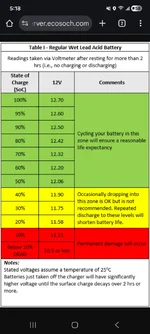
1) For some reason, Toyota chose a charging algorithm that charges / maintains the 12V battery at ~60-65% charge level instead of charging it to a more typical 90-100%.
2) This leaves the battery with little charge reserve for activities such as camping or working on the car, or sudden drop to sub-freezing temperatures.
3) Flooded lead-acid batteries work best and last the longest if cycled between 100 and 60% charge level. Cycling the battery to or below 40% causes sulfation, which quickly results in loss of storage capacity. This loss of capacity exacerbates the issue in point (2).

This problem can be (partially) remedied by replacing the OEM flooded lead-acid battery with one that can tolerate deep discharge cycles better, like an AGM one. Deep cycle batteries are commonly used in application such as boating or RVs.

Ultimately, the solution would be implementing a charging algorithm that keeps the battery fully charged. Disconnecting the battery monitoring sensor to force the system to default to a higher float voltage (14+V) will result in off-gassing and require periodic addition of distilled water (like it used to be in the 1960s or 70s). It may also damage the battery in hot climate.
Katekebo, the charging algorithm to a 60-65% charge, do you know if that percentage is determined by a voltage measurement of the battery (once the battery voltage reaches X volts the voltage sent to the 12V is reduced) or by time (after X minutes the voltage sent to the 12V is reduced)? Your previous post stated there is an increased voltage charge to the battery when the vehicle is shifted into park.

I found a YouTube video from England stating that 12V battery charging is an issue across the Toyota line. His remedy is installing a lithium ion battery. Lithium ion are awesome in many scenarios and would be fine in England however lithium ion batteries and cold climates are not a good mix. It also doesn’t fix the charging scenario issue.

I am perplexed as to how this is an intermittent algorithm issue and not an issue with every Toyota rolling off the line. Case in point that my wife’s RAV4 hybrid is around 6 years old, still has the original battery and has never had a starting issue.

On a side note, there is a heat vent blowing out from behind the right rear seat. I am curious if that heat vent also supplies any heat to the battery compartment even if it is residual. Will take my IR camera to the area to see what I find.
 
It's small comfort to hear that many LC owners have similar issues to ours. Our LC already would not start last winter when it was only several months old. This year it went from bad to worse and ended up with a tow truck ride to the dealer. The starting battery failed its test, resulting in battery replacement on warranty. I see that the new battery has a large "TOYOTA" label, unlike the original battery; not sure if that will make a difference.

The dealer suggested installing a trickle charger directly at the starting battery; probably better than hooking it to the boost points in the engine compartment. Running the trickle charger cord to the outside presented a problem as the LC will not shut off its systems and headlights if a rear window is open even a small crack. But thanks to another poster on this forum and their suggestions and pictures, it didn't take long to run the cord at the back of the LC. Now, when parked outside in the winter, one has to plug in two cords, one for the block heater at the front and another for the trickle charger at the rear. We also put the LC in the heated garage and only plug in the trickle charger there.

I expect that the combination of the block heater and trickle charger would start the LC in cold temperatures. If not, one could add a battery blanket. One owner from the Yukon had his battery fail in the middle of a long drive, probably because the battery became too cold to function. A long tow followed. The battery compartment next to the cold rear fender likely becomes very cold. My suggestion for that type of situation is to drive with the cover off of the battery compartment, to allow warmer air from the car interior to keep the battery thawed. Of course, also keep the largest NOCO booster fully charged and warm. If heading out into an isolated area, in winter or summer, it also would be a good idea to take survival gear, such as a 5 Star Woods sleeping bag, candles, water, food, a portable Starlink or InReach, etc. You don't want to become an item on "Outdoor Disasters."

Had we known of these issues, there is no way we would have bought the LC. But to get rid of it with 12,000 km could result in a huge loss, so we will stick with it for now. Toyota, why are you even selling these in Canada or in other areas with a cold climate? Maybe it's time for recall to fix these issues.
My question with regard to the case in the Yukon is whether the battery failure, possibly due to freezing or the voltage dropping caused the LC to actually shut down while in motion driving down the highway? If it did then we are dealing with a potential significant safety issue. Are there any reports of a system shutdown while the LC is in motion?

Reason I'm asking is I travel the northern route above Lake Superior on Highway #11 in the winter where the temperatures can often be Minus 40C or colder. It's a long desolate stretch of highway. I'm prepared with a survival kit including candles & flares, extra gas cans (premium as last trip the gas station had run dry of premium) and a basic tool kit. If there's a risk of the LC just stopping, in the middle of the road, because of a 12V battery failure or low voltage where the next town is 100's of KM away this could potentially be very dangerous. Opening the battery compartment would be useless as the back of the vehicle is full of gear so interior heat wouldn't get to it.
 
Last edited:
Katekebo, the charging algorithm to a 60-65% charge, do you know if that percentage is determined by a voltage measurement of the battery (once the battery voltage reaches X volts the voltage sent to the 12V is reduced) or by time (after X minutes the voltage sent to the 12V is reduced)? Your previous post stated there is an increased voltage charge to the battery when the vehicle is shifted into park.

I found a YouTube video from England stating that 12V battery charging is an issue across the Toyota line. His remedy is installing a lithium ion battery. Lithium ion are awesome in many scenarios and would be fine in England however lithium ion batteries and cold climates are not a good mix. It also doesn’t fix the charging scenario issue.

I am perplexed as to how this is an intermittent algorithm issue and not an issue with every Toyota rolling off the line. Case in point that my wife’s RAV4 hybrid is around 6 years old, still has the original battery and has never had a starting issue.

On a side note, there is a heat vent blowing out from behind the right rear seat. I am curious if that heat vent also supplies any heat to the battery compartment even if it is residual. Will take my IR camera to the area to see what I find.
Open circuit voltage after "rest" time.
 

Attachments

  • Screenshot_20251201_171803_Chrome.webp
    Screenshot_20251201_171803_Chrome.webp
    105.5 KB · Views: 169
I am perplexed as to how this is an intermittent algorithm issue and not an issue with every Toyota rolling off the line. Case in point that my wife’s RAV4 hybrid is around 6 years old, still has the original battery and has never had a starting issue.

My father bought a '25 RAV4 this summer, and his battery is chronically undercharged. I put a reader on it and it was hovering around 12.3V via OBDII. He has had a few pop-ups on the instrument cluster indicating something about battery charging. The dealer found no codes, and I found none when hooking up myself. They told him they will replace it when the time comes.

I have been periodically checking the Land Cruiser, and so far so good in terms of finding a discharged state. I think if my own battery goes south, the path of least frustration is to upgrade it rather than have the dealer replace it with an identical minimalist battery. I have had weak batteries in brand new vehicles from both VW (Varta) and Jeep (Mopar), and suspect if someone gets what used to be considered a normal lifespan from an OEM battery these days it is the exception rather than the rule.
Understood. I have the time and patience (at least for now) to see how this plays out and then to discuss with Toyota. Seriously considering installing a Victron SmartShunt so I can track the 12V battery status in real time. If nothing else it will help provide real time data for any future discussions with Toyota and data for the geeks on here to dive into. I mentioned this to my wife last night who raised an eyebrow at me and suggested I wait until above 0 temps at least… LOL I can’t argue with that logic. If the battery fails again this might change but until then… we will see what happens. I will cold soak everything after installing the block heater this weekend and see what happens with the negative temps over the next month. While it’s still under warranty and really new status with the dealership seems like the best time to do this.


 
My father bought a '25 RAV4 this summer, and his battery is chronically undercharged. I put a reader on it and it was hovering around 12.3V via OBDII. He has had a few pop-ups on the instrument cluster indicating something about battery charging. The dealer found no codes, and I found none when hooking up myself. They told him they will replace it when the time comes.

I have been periodically checking the Land Cruiser, and so far so good in terms of finding a discharged state. I think if my own battery goes south, the path of least frustration is to upgrade it rather than have the dealer replace it with an identical minimalist battery. I have had weak batteries in brand new vehicles from both VW (Varta) and Jeep (Mopar), and suspect if someone gets what used to be considered a normal lifespan from an OEM battery these days it is the exception rather than the rule.
It's an issue with all Toyota (and Lexus) hybrids.
 
  • Like
Reactions: SJR
Back
Top Bottom