- Thread starter
- #21
This is all really helpful. Thank you. I am somewhat familiar with BMS and float voltage from our trailer so all of this makes sense. Follow-up question, if the voltage jumps to 14.2V when the LC is put into park, then letting it run in park for a few minutes before hopping out especially when it’s cold should help?The 12V battery is managed / charged by the hybrid inverter. As the LC doesn't have an alternator, the entire 12V system is "slaved" to the high voltage DC system comprised by the hybrid motor-generator, the hybrid battery and the inverter. The inverter takes high DC voltage from the hybrid battery (or rectifies the AC generated by the motor-generator) and steps it down to 12V to power the 12V circuit and charge the 12V battery.
There are basically five modes of operation of the hybrid system:
1) Engine on, charging hybrid battery. The engine turns the motor-generator, the inverter takes the AC generated by the motor-generator, rectifies it and charges the hybrid battery.
2) Engine on, motor-generator boosting torque. The inverter takes high voltage DC from the hybrid battery, converts it in AC and powers the motor-generator.
3) EV mode. Engine is off, inverter takes high voltage DC from the hybrid battery, converts it in AC and powers the motor-generator to move the car.
4) Regenerative braking. Engine can be on or off. Car's wheels move the motor-generator, the inverter takes the AC generated by the motor-generator, rectifies it and charges the hybrid battery.
5) Starting the engine. This one is a bit more complicated, so I will explain it further below.
In the first four modes, the 12V circuit is powered by the inverter by stepping down high voltage DC from the hybrid battery circuit. It can charge the 12V battery regardless of the engine being on or off, as long as there is enough energy stored in the hybrid battery.
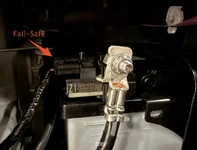
However there is a caveat. When the car us turned off, the main high voltage relay completely isolates the hybrid battery from the inverter. The inverter needs the 12V battery to "wake up" and close the main high voltage relay. Hence, the car cannot "wake up" if the 12V battery is low. So, in spite of having a potentially huge energy "reserve" in the hybrid battery, the 12V battery is essential for the car to "wake up" after being powered off.
Once the inverter "wakes up", it checks the charge status of the hybrid battery. If there is enough juice in the hybrid battery, it will use the motor-generator to start the engine. If the hybrid battery is low, it will start the engine using a conventional starter and the 12V battery. In theory, this should make the LC totally fool-proof and allow to start the engine even if the hybrid battery is low. But there is a gap between theory and practice. When the 12V battery is low, the hybrid system goes into a fault mode which we are already aware of.
One last detail. Because normally the engine is started by the motor-generator, this would leave the 12V starter unused and eventually it would just "freeze up". In order to prevent it, the engine is started by the conventional starter and 12V battery every time after the fuel door is opened. This makes sure that the starter is used at least once every now and then.
All this sounds wonderful in theory. But in practice, the execution is less than perfect, and we already know that if the 12V battery gets below certain level, the inverter's brain gets confused and the car won't power up.
This isn't different from other Toyota hybrids. Complaints about hybrids being dead after being left parked for a few weeks are very common on Toyota forums. However, LC appears to be particularly bad. My wife's car is a Lexus NX hybrid. I have measured the voltages in different conditions, and at least in the Lexus the float/maintain voltage of the 12V circuit is 13.2V, so the 12V battery gets fully charged if you drive the car long enough. But in the LC, Toyota decided (for some obscure reason) to make the float/maintain voltage 12.8V, below the minimum voltage required to charge the 12V battery.
Also, it appears that the 12V charging algorithm is actually quite complicated. For example, the float/maintain voltage is 12.8V most of the time. But as soon as the car is placed in Park, the voltage jumps to 14.2V. Also, when ambient temperature is low (around 50F), the float/maintain voltage is increased to 13.2V. So it seems that Toyota did think about different conditions and requirements to keep the 12V battery healthy, but the actual implementation is faulty and needs some fine-tuning.
As all this is managed by the inverter's software, there is no easy way to change it (at least for us). It should be easy for Toyota to update the inverter software, though.
Last edited: